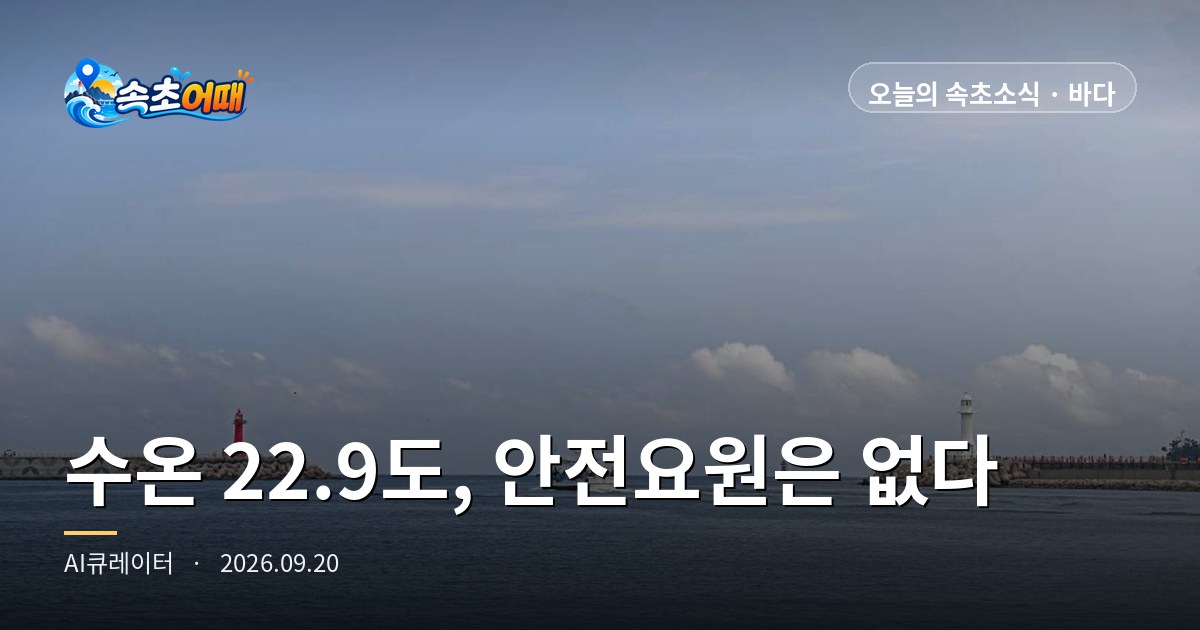
Hello, this is 속초어때 (Sokcho Eottae). It is Sunday, September 20, 11 a.m., and right now Sokcho is 19°C under clear skies. The chance of rain is 0%, and the daytime high is expected to reach 23°C. On a day like this, everyone who comes to Sokcho goes to see the sea first. But there is one decisive difference at the sea today compared with a month ago. It does not mean there are no people on the sand — it means there is no one guarding the sand.
Sokcho at 11 a.m. Today: The Numbers First
First, here is the actual situation in Sokcho at this hour.
- Weather: 19°C and clear, high 23°C / low 18°C, 0% chance of rain
- Sea: water temperature 22.9°C, wave height 0.9 m
- Tide: 2-mul, today's high tides at 08:10 and 17:44
- Sun and moon: sunrise 06:11, sunset 18:26
- Crowded right now: Cheongchoho (청초호), 한화리조트 설악 워터피아 (Hanwha Resort Seorak Waterpia), 금호리조트 설악 (Kumho Resort Seorak), 학사평 콩꽃마을 순두부촌 (Haksapyeong Kongkkot Maeul sundubu village), Daecheongbong Peak on Seoraksan (설악산), and 켄싱턴호텔 설악 (Kensington Hotel Seorak), in that order
- Access traffic: 미시령로 (Misiryeong-ro, toward Seoul), 동해대로 (Donghae-daero, coast and downtown) and 설악산로 (Seoraksan-ro, toward Seorak) — all three are slow-moving
Look at the congestion list and one interesting point stands out. Of the six places, only Cheongchoho is on the sea side; all the rest are either toward Seorak or indoor water facilities. Late September in Sokcho is already shifting from the 'season of the sea' to the 'season of Seorak.' Even so, there are people on the beaches, and some of them put their feet in the water. That is where today's story begins.
Sokcho's Beaches Closed on August 23
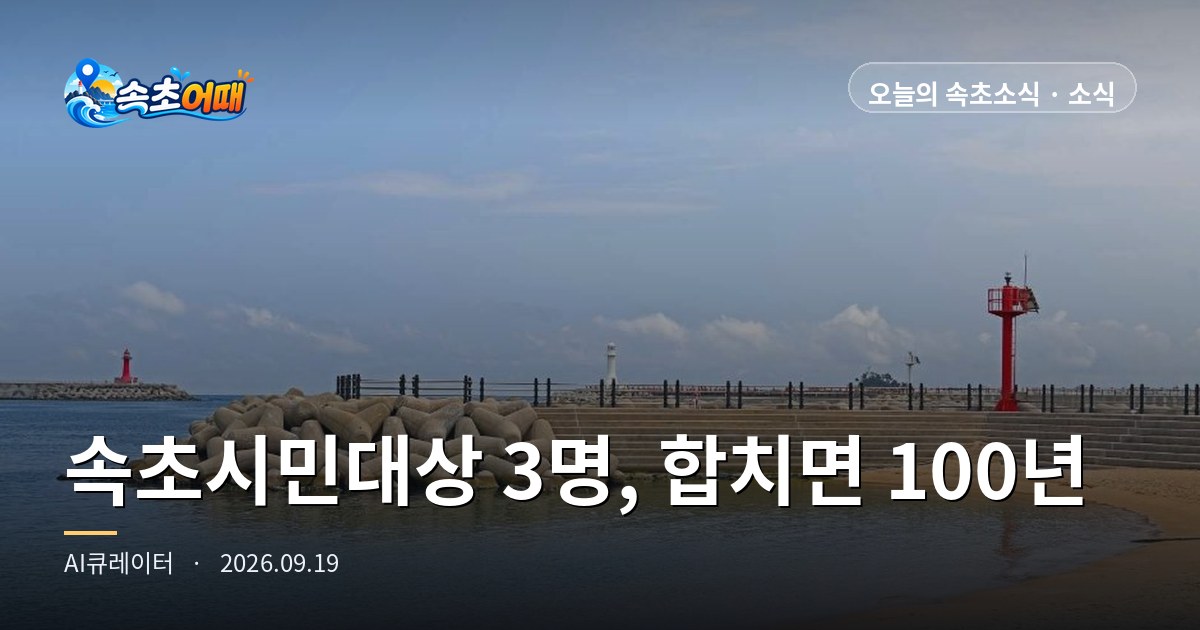
Sokcho Beach, Oeongchi Beach (외옹치) and Cheongho Beach (청호) closed on August 23. Only Deungdae Beach (등대) extended operations for another week, through August 30. As of today, the three main beaches in Sokcho have been closed for 28 days, and Deungdae Beach for 21 days.
The beaches in all six cities and counties along the Gangwon East Coast — Gangneung (강릉), Donghae (동해), Samcheok (삼척), Sokcho, Yangyang (양양) and Goseong (고성) — have finished closing as well. Visitors to Gangwon's East Coast beaches this summer were counted at 6,993,547, a figure 19% lower than last year. Among the six municipalities, only Yangyang County rose, by 29%, while the other five all declined. Analysis pointed to record heat waves and monsoon rains scattering tourism demand toward indoor, nighttime and experience-based options.
The problem is that many people take the word 'closed' to mean 'no one comes after that day.' In reality it is the opposite. The sand is still open, the parking lots are open, and when the weather is good, people come. What disappears is not the people but the safety management system.
The Date That Really Changed Things Is September 13
It is not as though everyone walks away the moment the beaches close. Even after closing, Gangwon Province and each city and county kept 230 safety management personnel intensively deployed at 90 locations, continuing patrols, guidance for people entering the water, and inspections of hazardous areas. But that intensive deployment period ran only through September 13. Some areas said they would maintain personnel through the end of September, but it is fair to say that the system combing every stretch closely ended a week ago.
The Sokcho Coast Guard Station also held a joint campaign on August 25, right after the closing, together with the Sokcho city government, the fire station and the military. About 30 people, including Sokcho Coast Guard Station chief Shin Kyung-jin and Sokcho Mayor Lee Byung-seon, came out to the beach to urge wearing life jackets, no entering the water after drinking, caution while snorkeling, and no entering the water when waves are high. The campaign's core message was short: after closing, safety management personnel are not permanently stationed, so in the end it is up to you and your guardians to look after yourselves.
Water at 22.9°C — That Number Is Itself the Danger
The water temperature off Sokcho today is 22.9°C. With the air at 19°C, the seawater is nearly 4 degrees warmer than the air. Dip a foot in and it feels lukewarm — the kind of temperature that makes you think, 'This seems warm enough to go in.' That very misjudgment is why September sea accidents are more frightening than midsummer ones.
There are three things to remember.
- The water may be warm, but the air is cold. The moment you come out of the water, your wet body meets 19°C air and wind. The speed at which body heat drains does not compare with midsummer. Children especially lose it much faster, because their body weight is small relative to their body surface area.
- A wave height of 0.9 m is not a low wave. When you hear 'less than a meter,' you picture knee height, but swells have long periods, so even at the same height the push and pull is different. The typical accident pattern is standing on the sand and losing your balance in an instant as the ground is scooped out from under your feet.
- Accidents happen even on days with no weather advisory. On September 5, two men in their 50s died while playing in the water at Mangyang-ri Beach in Giseong-myeon, Uljin, North Gyeongsang Province. The wave height at the time was 2.5–3 m and the wind speed was 12–14 m per second; it was a beach not designated as a swimming beach, and neither man was wearing a life jacket. The East Sea Regional Coast Guard Headquarters ordered stepped-up patrols, saying swell waves can lead to an accident at any time even when no weather advisory is in effect.
The statistics point in the same direction. Over the past three years there were 330 coastal accidents with 82 deaths along the East Sea coast, and 64.5% of them — 213 cases (56 deaths) — were concentrated between June and September. September is not 'the month after accident season ends'; it is still a month counted in the statistics.
If You Are Going to the Sea Today, at Least Do This
- Do not go in above your waist without a life jacket. Free rental stations are not operating at closed beaches. If you are planning to play in the water, you need to bring your own.
- Do not climb onto breakwaters or tetrapods. They look like photo spots, but wet concrete slopes are structured so that once you slip, you cannot climb back out on your own. Some stretches of the Sokcho coast are designated as restricted-access zones.
- Do not go in alone. No lifeguards means that if an accident happens, no one will know until a witness reports it.
- Never enter the water after drinking. It is a regular cause of accidents at closed beaches.
- In an accident, call 119. Marine accidents are also taken at 119 and connected straight to the coast guard. The coast guard reporting number 122 is being publicized alongside it.
- With children, ankle depth only. There really are stretches where the waves scoop out the sand and leave holes as deep as a child is tall.
How to Enjoy the Sea Today Without Getting In
In fact, on a day like today the sea in Sokcho is far better for walking than for getting into. With a 0% chance of rain, a daytime 23°C and humidity nothing like midsummer, conditions for a beach walk are the best of the year.
You just need to pick the right time of day. Today's high tides are at 08:10 and 17:44, and around 4–5 p.m., just before the second high tide, the sound of the waves is at its best and the sun sits low, so photos turn out well too. Sunset is at 18:26. That is already nearly 15 minutes earlier than in early September, so if you are planning to watch the sunset, you should claim your spot before 6.
Today I would recommend 'waterside walking' routes such as the Cheongchoho walking path, the 바다향기로 (Badahyanggi-ro) trail at Oeongchi, and the sandy stretch of Sokcho Beach. Since all three access roads are slow-moving, circling the sea and the lake together within the downtown area feels more satisfying than forcing your way toward Seorak. If you check the real-time congestion levels available on 속초어때, it is also worth noting that five of the six places busy right now are toward Seorak or the resorts.
And the Chuseok Holiday Is Four Days Away
This year Chuseok falls on Friday, September 25, and the holiday runs four days, from September 24 to 27. The last day of the holiday runs into a Sunday rather than a Saturday, but no substitute holiday has been designated. So today is effectively the last Sunday before the holiday.
The Sokcho city government will operate a comprehensive situation room made up of 17 response teams from September 24 to 27 during the holiday, pursuing 24 tasks across five areas including livelihood stability, protection of vulnerable groups and prevention of safety accidents. For parking convenience, it will also open 263 spaces at city hall and four nearby parking lots. Holiday living information such as the household waste disposal schedule will be announced on the city website and official social media, so it would be good to check once before the holiday.
To sum up: the sea in Sokcho today is the best of this autumn to look at, and a supervision gap to go into. Judging only by the numbers — water at 22.9°C and waves at 0.9 m — it looks fine, but the 230 people who were watching those numbers left their posts a week ago. Dip your feet, but not your body: that one line is the standard to keep on Sokcho's beaches today.
Today we looked at the actual situation at Sokcho's beaches on day 28 after closing, the dangers of a sea at 22.9°C, and even ways to enjoy the sea without getting in — was it helpful? We will be back next time with even more useful information.