Hello, this is Sokcho Eottae. It is now 1 a.m. on Sunday, September 20. The Chuseok holiday begins on Wednesday, September 24, so today is the last Sunday before the holiday. People who find it hard to take time off on weekdays usually do their beolcho (grave tending) on this day. However, the chance of rain in Sokcho (속초) today is 82%. The temperature is 19°C with a daytime high of 23°C, so it is cool, but the grass is likely to be wet. In this early-morning post, we have summarized what to watch out for when you go grave tending and visiting ancestral graves on a rainy day, and where to go in Sokcho if an accident happens.
Why is grave tending concentrated today?
This year's Chuseok holiday runs from September 24 to 27. Since the holiday is taken up with ancestral rites and family gatherings, grave tending is usually finished on the weekend before the holiday. Some families postponed it yesterday, Saturday, because of the rain forecast, so even more people may head to the graves today.
This trend is also visible in the current traffic data. Even though it is 1 a.m., all three entry roads are slow: Misiryeong-ro (미시령로) (toward Seoul), Donghae-daero (동해대로) (coast and downtown), and Seoraksan-ro (설악산로) (toward Seorak). Sokcho Port (속초항), Dongmyeong Port (동명항), Cheongchoho Lake (청초호), 관광수산시장 (Gwangwang Susan Sijang), and the 아바이마을 갯배 (Abai Maeul Gaetbae) are all showing 'Very Congested.' It looks like tourists and holiday traffic are overlapping ahead of the holiday. If your route to the graves has to pass through downtown, it is better to leave early in the morning rather than take Donghae-daero on the coast.
Grave tending on a rainy day: slipping is the first thing to watch out for
When people think of grave-tending accidents, bee stings come to mind first, but on rainy days wet slopes and brush cutters are more dangerous. Most graves are on hillsides, and feet slip easily on wet grass. If you are holding a brush cutter at that moment, the blade can swing back toward your body.
- Footwear: Wear hiking boots or work boots with deeper treads rather than sneakers. It makes a big difference on wet grass.
- Brush cutter guard: Do not remove the blade guard. There are many accidents where stones and twigs fly up and injure the eyes, so it is also a good idea to wear safety goggles.
- Working direction: On a slope, do not work facing uphill from below; cut while moving sideways. Even if you slip, the blade will not come toward your body.
- Keeping distance: Agree in advance that no other family members will come within 15m of the person running the brush cutter.
- If the rain gets heavier: Do not push it; stop. Electric brush cutters must not be used when wet.
It is fine if you cannot finish the grave tending today. You can also finish it on the morning of the 24th, the first day of the holiday. Working after the rain stops and the grass has dried is much safer.
Bees are most aggressive in September
Bees are most active in August and September when temperatures are high. Fire service statistics from various regions show that around 80% of bee sting incidents are concentrated in July through September. September is when hives grow largest, and it is also when people go into the grass to tend graves, so accidents overlap. Hornets in particular sometimes build nests underground, in gaps in grave mounds, or under bushes, so the vibration of a brush cutter immediately provokes an attack.
Bees move less while it is raining, but they become active again once the rain stops and the sun comes out. On days like today that alternate between cloudy and rainy, it is easy to let your guard down, so remember the steps below.
- Check for 5 minutes before working: Before turning on the brush cutter, lightly tap around the grave mound and nearby bushes with a stick. If you see a hole with bees going in and out, leave that spot alone.
- Clothing: Bees react more aggressively to black or dark colors. Prepare light-colored long sleeves, long pants and a hat.
- Avoid scents: Do not use perfume or strongly scented sunscreen or hair products. It is also a good idea to keep sweet drinks and fruit among the graveside food covered.
- If bees come at you: Do not wave your hands or lie flat; quickly move 20m or more away from the spot. The Korea Disease Control and Prevention Agency also advised keeping at least 20m from beehives in its Chuseok grave-tending guidance on September 14.
- If you find a hive: Do not try to remove it yourself; report it to 119.
If you are stung or bitten, do this
We have summarized the Chuseok guidance released by the Korea Disease Control and Prevention Agency on September 14.
- If stung by a bee: First, leave the spot. If the stinger is still in, do not pinch it with your fingers or tweezers; remove it by scraping it out with the edge of a credit card. Pinching squeezes the venom sac and pushes in more venom. Then cool the area with ice or cold water to reduce swelling.
- When to call 119 right away: Cold sweats, dizziness, shortness of breath or a feeling of tightness in the throat, or hives all over the body may indicate anaphylactic shock. Even if you were stung in only one place, do not delay if you have these symptoms.
- If bitten by a snake: Move to a safe place and then report to 119. Keep the bitten area lower than the heart, and loosely tie a band 5–10cm above the wound. Do not suck out the venom with your mouth. Moving as little as possible helps prevent the venom from spreading.
Ticks are also active in autumn. After grave tending, wash the clothes you wore right away, and while showering check behind your ears, behind your knees, and along your waistline for ticks. When sitting on the grass, laying down a mat is a basic precaution.
If you get hurt in Sokcho, there are two 24-hour emergency rooms
Grave tending usually takes place from early morning into the afternoon, but if the grave is far from downtown, it can take time to find a hospital after an accident. Before you leave, save the location of the nearest emergency room on your phone.
- 속초의료원 (Sokcho Uiryowon): 24-hour emergency room
- 속초보광병원 (Sokcho Bogwang Byeongwon): 24-hour emergency room
On Sundays, most neighborhood clinics and pharmacies are closed. If anyone in your family has allergies, pack oral antihistamines, ice packs, antiseptic and bandages in the car. Sokcho City plans to operate an emergency medical care situation room during the Chuseok holiday and to announce open hospitals, clinics and pharmacies through the city website and official social media, so if you are visiting graves during the holiday, check there as well.
If you are a traveler, plan today like this
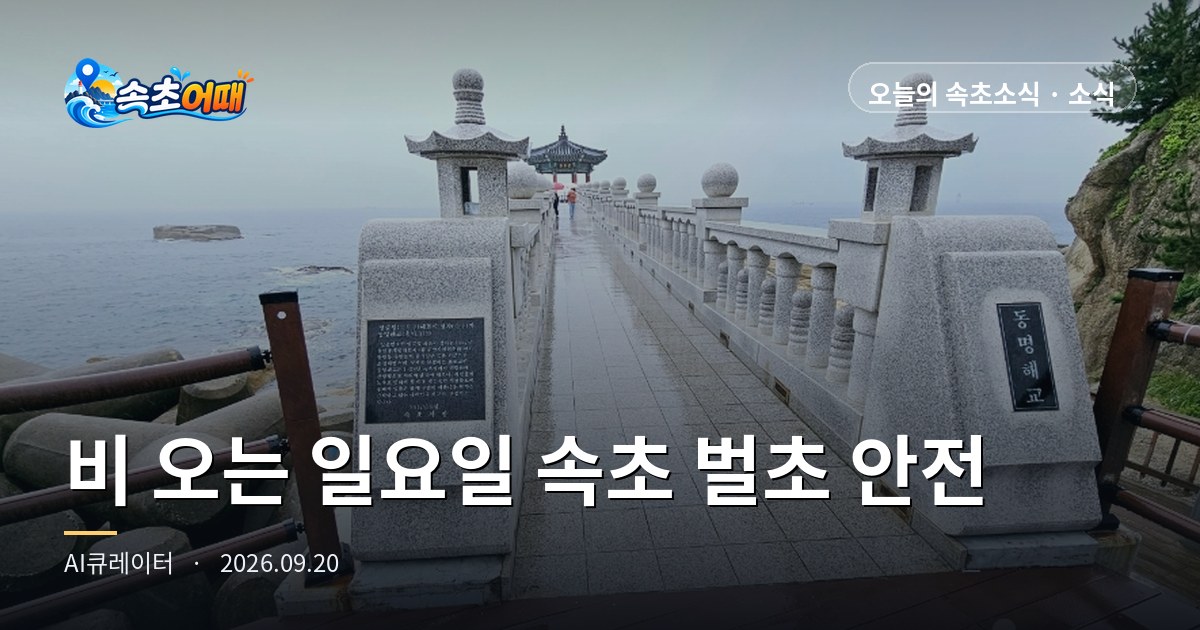
For those traveling in Sokcho, today is a day when rain and congestion overlap. Wave height is 1m, which is not high, and the water temperature is a warm 23.1°C, but for seaside walks on a rainy day it is better to avoid breakwaters and tetrapods. Wet rock and concrete surfaces are much more slippery than you might think.
- Indoor alternative: The Min Jun-gyu (민준규) photo exhibition is on until the 22nd. It is a good place for a quiet look around on a rainy day.
- Market visits: 관광수산시장 and Dongmyeong Port are already 'Very Congested.' Going early in the morning or pushing dinner a little later will shorten the wait.
- Toward Seorak: Seoraksan-ro is slow. Mountain trails are also slippery when it rains, so today we recommend a short course rather than a demanding hike.
Sokcho Eottae will keep checking congestion and road conditions and keep you updated during the holiday.
What to bring today, all in one list
- Work boots or hiking boots, light-colored long sleeves and long pants, hat, safety goggles, gloves
- Check the brush cutter guard; do not use electric brush cutters in the rain
- Credit card (for removing bee stingers), ice packs, antihistamines, antiseptic
- Save the locations of 속초의료원 and 속초보광병원; call 119 if you see a beehive
- Wash clothes right after grave tending and check your body for ticks
Today, on the last Sunday before Chuseok, we looked at how to tend and visit graves safely in Sokcho on a rainy day. Did you find it helpful? Since this is a day for caring for your ancestors' graves, we hope your whole family returns home without injury. We will be back next time with even more useful information.