Hello, this is 속초어때 (Sokcho Eottae). As of 6 p.m. on Sunday, September 20, the temperature in Sokcho is 21°C and the sky is clear. Chance of rain 0%, daytime high 23°C and overnight low 18°C. For late September, it is very mild weather — no need to worry much about an umbrella or an extra layer. But the most important number in Sokcho this evening is not the temperature. It is sunset at 18:26, and congestion on Misiryeong-ro toward Seoul. As you read this, the sun goes down in 26 minutes, and the three roads out of Sokcho have already slowed.
26 minutes of daylight left, and the sea has just finished draining
Sunrise in Sokcho today was 06:11 and sunset was 18:26. Ten days from now, on September 30, sunset will be 18:11. That means we are in the stretch where the evening light shortens by a full 15 minutes in ten days. Wednesday, September 23, three days from now, is the autumnal equinox, so once this week passes, nights in Sokcho grow longer than days. If you are planning photos at the beach, it is worth remembering that this is the season when ‘I’ll head out after dinner’ no longer works.
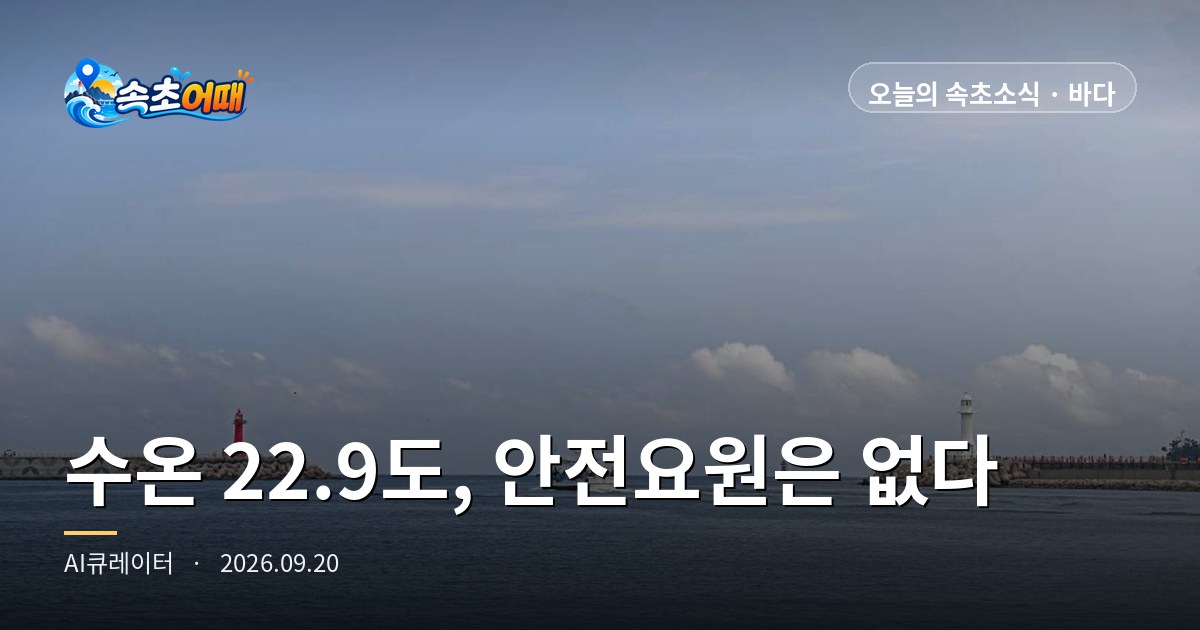
Sea conditions are good as well. Water temperature 23.5°C, wave height 0.7 m. Today is day 2 of the tidal cycle (2-mul), with high tide at 08:10 in the morning and low tide at 5:44 p.m. Right now the water has just pulled back as far as it goes, so the rocky shelves and the undersides of the tetrapods that are usually submerged are exposed. That said, unlike the Yellow Sea, the East Sea has a very small tidal range — the difference in water level between today’s high and low tide is only about 17 cm. The reasoning of ‘the water has gone out, so I can walk in that far’ does not hold on the East Sea. A wave height of 0.7 m looks calm to the eye, but if you are standing on a breakwater or a rock shelf, every so often a high swell comes straight over your feet. If you are with children, I recommend going down only as far as the point where your shoes get wet.
Three of the six crowded spots right now are lodgings
As of 6 p.m., the places registering as crowded are six: Cheongchoho (청초호), 한화리조트 설악 워터피아 (Hanwha Resort Seorak Waterpia), 금호리조트 설악 (Kumho Resort Seorak), 학사평 콩꽃마을 순두부촌 (Haksapyeong Kongkkot Maeul sundubu village), Daecheongbong Peak on Seoraksan (설악산), and 켄싱턴호텔 설악 (Kensington Hotel Seorak). What stands out here is that 워터피아, 금호리조트 and 켄싱턴호텔 — three lodging facilities — are all crowded at once on a Sunday evening.
Normally on a Sunday evening the lodgings empty out and only the roads jam up. Today it is the reverse: the lodgings are full. The reason is on the calendar. This year Chuseok falls on Friday, September 25, and the statutory holiday runs from Thursday, September 24 through Saturday, September 26. Add Sunday the 27th and it becomes four days; take the 21st, 22nd and 23rd as annual leave and you get nine straight days off, from yesterday, Saturday the 19th, through Sunday the 27th. The people who chose those nine days are not packing up today. That is why the resorts are crowded even at 6 p.m., why Daecheongbong registers at this hour, and why there is a line at the sundubu village.
For reference, Monday, September 28 is not a substitute holiday. The last day of the holiday, the 26th, does fall on a Saturday, but for the Seollal and Chuseok holidays a substitute holiday applies only when the dates overlap with a Sunday or another public holiday. This holiday ends after four days — if you have not booked a room yet, factor that in.
The three roads out of Sokcho, and how they look right now
At the moment the access and exit roads stand at congestion on Misiryeong-ro (toward Seoul), congestion on Donghae-daero (coast and downtown), and slow-moving traffic on Seoraksan-ro (toward Seorak). It is no coincidence that all three slowed at the same time. The options for getting from Sokcho to the capital region effectively converge into these three branches.
- Misiryeong-ro → Misiryeong Tunnel → toward Inje: the shortest route and the first to jam. The tunnel toll is 3,300 KRW for a passenger car. This road opened in 2006 and is a privately financed toll road collecting tolls for 30 years, through 2036.
- Seoraksan-ro → National Route 44 over Hangyeryeong → Inje and Hongcheon: currently slow-moving. It is the textbook detour when Misiryeong is jammed, but it is a mountain pass, so after the sun goes down you have to handle the curves and the fog.
- Donghae-daero → Yangyang → Seoul–Yangyang Expressway: it runs through downtown, so on a weekend evening it backs up before you even get onto the expressway.
To give you a sense of how far the actual travel time can stretch, here is one record from a past peak season. Seoul to Sokcho normally takes around 2 hours 20 minutes, but during the summer holiday return-traffic jams there was a case where the stretch from Yangyang JC to Misa IC took 3 hours 21 minutes at an average speed of 45 km/h, and on worse days it reached 3 hours 40 minutes. In particular, the Seorak IC to Seojong IC section of the Seoul–Yangyang Expressway toward Seoul crawls in stop-and-go traffic at an average speed in the low 10s of km/h. That is not to say today is at that level, but the conditions — a Sunday evening right before Chuseok — are by no means light.
So there are two realistic options. Get on the road right now, or eat dinner and move after 8 p.m. Setting off around 7 p.m., in between, is the worst choice. The sun has already set, and you hit the hour with the most cars on the road. If you check 속초어때’s real-time access-road information once before deciding your departure time, you can at least avoid the regret of ‘I shouldn’t have left at this hour’.
One more thing to add: since July 1, 2021, the Misiryeong Tunnel toll has been waived for vehicles belonging to residents of six cities and counties — Sokcho, Goseong, Yangyang, Inje, Yanggu and Hongcheon. It applies to one vehicle owned by a household, corporation or organization, for up to one round trip per day. If you are a Sokcho resident and have not registered yet, this week — when you will be coming and going a lot over the holiday — is a good time to take care of it.
And that is why 학사평 is busy
학사평 콩꽃마을 순두부촌 is on the crowded list not only because of the food. It is because of geography. 학사평 is the first village below Misiryeong. If you head from Sokcho toward Seoul on Misiryeong-ro, this is the last cluster of restaurants you meet before climbing the pass. In other words, the sundubu village being busy is almost the same as saying ‘a lot of cars are heading up to Seoul right now’. That is exactly why road information and crowding information should be read layered together rather than separately.
Knowing why it is sundubu of all things in 학사평 changes how that bowl tastes, too. This village had strong winds and granite sand mixed into its clay, making it land where grain did not grow well. The crop that bore fruit even in that soil was soybeans, and naturally the area planted with them grew. As recently as about 30 years ago, every household is said to have had a tofu mold. There was one more decisive turning point: the 학사평 reservoir construction in the 1960s. Over the more than four years of construction, modubu (모두부), sundubu (순두부) and kongguksu (콩국수) became known as drinking food for the laborers, and turned into a commercial dish. Grandmother Kim Young-ae, known as the originator, was born in 1916 in Yangyang and began making her living with tofu in 1965. Today, some 80 sundubu restaurants line the roadside. For reference, the place name ‘학사평’ comes from a legend about two white cranes soaring into the sky.
If you are torn about which of the 80-odd places to go to, here are just three practical criteria.
- Choose by the size of the parking lot. At this hour it is the surest way to avoid a wait. The number of parking spaces tells you more about turnover than the sign does.
- Check the closing time by phone. With tofu, when the ingredients run out, the day’s business is over. Closing times differ from shop to shop, and quite a few wrap up the dinner service early. To avoid wandering around once you arrive at the sundubu village, one call before you leave is the fastest route.
- Try ordering chodubu (초두부, sundubu) and modubu together. Chodubu, which is the state before setting, and modubu, which is pressed and set, are completely different foods even when made from the same soybeans. Tasting the two side by side is an experience you can only have in 학사평.
From a Sokcho resident’s point of view, today is not bad timing either. Once the holiday visitors arrive, there will be no seats in 학사평 again from next Thursday. Conversely, this evening the out-of-town cars are turning over on an ‘eat and leave right away’ cycle, so after 8 p.m. it actually gets quiet.
A 30-minute alternative when Cheongchoho is crowded
The only downtown spot among the six crowded places is Cheongchoho. Weather 21°C, light wind, 0% chance of rain. Evenings this good for a walk are not common, so of course people gather. But if you have 30 minutes to an hour before departure and still want to walk, there is no need to insist on the crowded stretch.
- Inside the breakwater, right after the water has gone out: low tide was at 5:44, so right now is when the intertidal zone is exposed at its widest. Just remember that 0.7 m swells come up now and then, so do not step onto the wet black areas.
- The sun sets in the opposite direction: Sokcho is on the east coast, so the sun goes down behind the ridgeline of Seoraksan, not into the sea. To get an evening photo, you need to turn your back to the sea and face the mountains to the west. The Seorak ridgeline is reddest for the 15 to 20 minutes right after 18:26.
- One indoor option this week: the Min Jun-gyu (민준규) photography exhibition runs through Monday, September 22. You will need to check the evening closing time with the venue, but it is worth keeping in mind for another day when it rains or the wind picks up.
Sokcho this week, just the dates
- Monday, September 22 final day of the Min Jun-gyu photography exhibition
- Wednesday, September 23 the autumnal equinox — from this day on, nights in Sokcho are longer than days
- Thursday, September 24 to Saturday, September 26 the Chuseok holiday, with Chuseok itself on Friday the 25th. Four days through Sunday the 27th, and Monday the 28th is not a substitute holiday
- Wednesday, September 30 property tax payment deadline — with the holiday in the middle, there are fewer bank business days than you might think. Mark it on your calendar today
- Wednesday, September 30 sunset 18:11 — by the end of this month, 6:30 in the evening is already night
To sum up, the answer for Sokcho this evening is simple. The weather is good and the sea is calm, but the roads are jammed. So it is better to set off right now, or empty a bowl in 학사평 and move after 8. Just avoid leaving at 7. If you are staying, do not miss the 20 minutes right after sunset at 18:26, the time when the Seorak ridgeline turns red. Once the equinox passes three days from now, you will have to wait quite a while to meet an evening like this again.
Today we have looked at Sokcho’s weather and sea as of 6 p.m. on Sunday, September 20, the situation on the three access roads, the real reason 학사평 sundubu village is busy, and when to set off for home — was it helpful? We will be back next time with even more useful information.