Hello, this is 속초어때 (Sokcho Eottae). It is 9 PM on Thursday, October 1, and Sokcho (속초) is clear at 17°C. Today's high is 22°C and tonight's low is 15°C, a daily temperature range of about 7 degrees, and the chance of rain is 4%. The sea temperature is 22.3°C, and the waves are calm at 0.8 m. Traffic is currently flowing smoothly on Misiryeong-ro (미시령로), Donghae-daero (동해대로) and Seoraksan-ro (설악산로).
Today Sokcho City released its report card for this summer's tourism, based on an analysis of credit card data from the Korea Tourism Organization's Korea Tourism Data Lab. Domestic tourism spending in Sokcho from June through August came to about 214.79 billion KRW, up 7.6% from the same period last year. Tourism spending nationwide grew 6.3% over the same period, so Sokcho came out 1.3 percentage points ahead. Today we'll go through the numbers one by one and lay out what to keep in mind this weekend over the National Foundation Day holiday, both for those of you coming to Sokcho and for those of you who live here.
Roughly the same number of people came, but they spent more
First, the point that stands out. In July and August, 5,971,200 out-of-town visitors came to Sokcho. July saw 2,685,774, up 0.3% from last year, and August saw 3,285,426, up 0.7%. In effect, the number of visitors stayed flat.
Yet tourism spending rose 7.6%. That means the money people spent during their stay grew faster than the number of people coming. This trend matches the data from the summer festivals. As 속초어때 covered earlier, many out-of-towners at Waterbomb Sokcho stayed in town after the performances ended and kept spending late into the night, and 108,000 people flocked to the Sokcho Beach Summer Festival. Rather than trips where people look at the sea during the day and leave right away, it looks like more people are staying into the night to eat and shop.
- June–August tourism spending: about 214.79 billion KRW (up 7.6% year on year)
- National growth rate: 6.3%
- July–August out-of-town visitors: 5,971,200 (July up 0.3%, August up 0.7%)
Out-of-towners account for 99.1% of spending: Sokcho runs entirely on a ‘guest economy’
Of the 214.7 billion KRW, out-of-towners spent about 212.94 billion KRW, or 99.1% of the total. Locals accounted for only about 1.85 billion KRW, or 0.9%. Of course, these statistics pull out ‘tourism spending’ separately, so the figure doesn't include all of residents' everyday spending. Still, it clearly shows how heavily Sokcho's tourism businesses rely on guests from outside the city.
For residents, what this number means is simple. The crowds in the main downtown shopping areas during holidays and festivals aren't a temporary inconvenience; they are how the local economy works. On the flip side, it also means that in the off-season, when guests leave, sales drop all at once. This is why the city has kept emphasizing ‘stay-oriented tourism’ and ‘night tourism’ when talking about its summer festivals lately.
In July and August, 60% of out-of-towner spending went to food and drink
Out-of-towner tourism spending in July and August was about 160.5 billion KRW. By business type, it breaks down like this:
- Food and beverage: about 96.9 billion KRW (about 60%)
- Shopping: about 36.3 billion KRW (about 23%)
- Accommodation: about 10.4 billion KRW (about 6%)
Food and drink plus shopping comes to about 83%. Out of every 10 KRW out-of-towners spent in Sokcho, 6 KRW went to eating and drinking and a little over 2 KRW went to shopping. The saying that a trip to Sokcho is really ‘a trip to eat’ has now been confirmed by the numbers.
Accommodation's small 6% share needs to be read with some care. This data is based on card payments, so depending on where and how payments were recorded, the share for each business type may differ from what people actually experience. It's more accurate to read it alongside another indicator showing a high rate of overnight stays.
Overnight guests at 3.5 times the national average
What sets Sokcho apart from other areas most is that people ‘stay the night.’ Among out-of-town visitors, the share who stayed overnight was 26.2% in July and 26.6% in August. The average for basic local governments nationwide in the same months was 7.4% and 7.7%, making Sokcho's figure about 3.5 times higher. The average length of stay was also about 2.5 days.
Being two to three hours by car from Seoul, and having a route where it's hard to see both the sea and Seoraksan (설악산) in a single day, seems to naturally lead to stays of one night or more. Staying one more day adds a dinner and the next morning's breakfast, and that feeds directly into the 96.9 billion KRW in food and beverage sales.
No. 1 summer attraction: 속초관광수산시장
A ranking of the most popular attractions among out-of-towners from June to August, based on navigation searches, was also released.
- No. 1: 속초관광수산시장 (Sokcho Gwangwang Susan Sijang)
- No. 2: Sokcho Beach (속초해변)
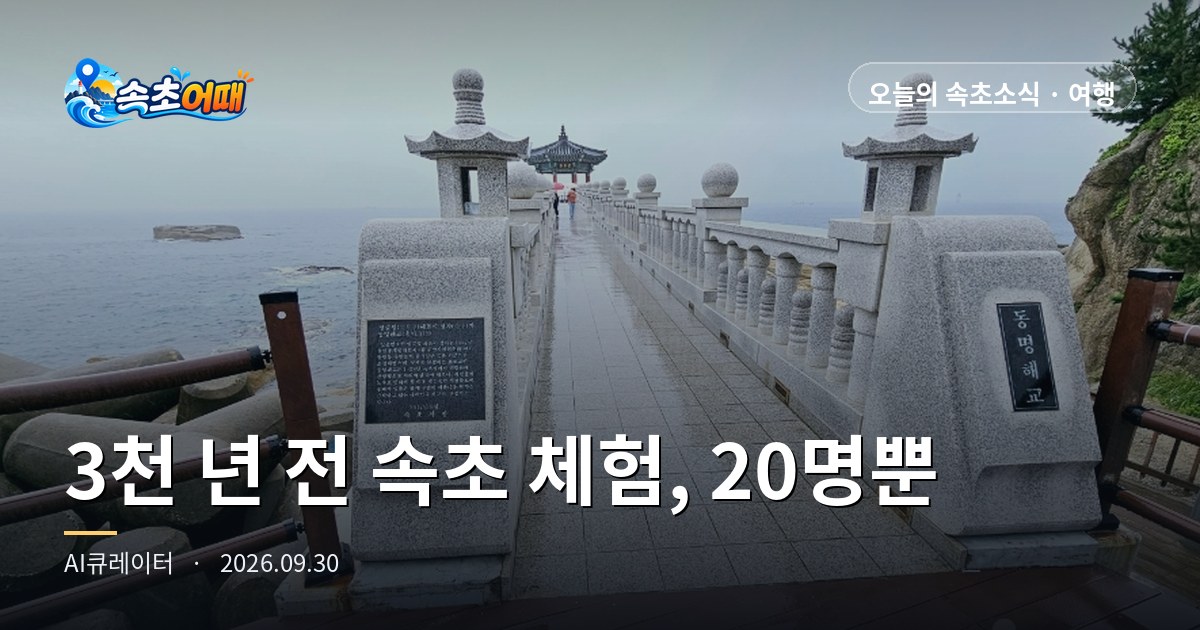
- Also near the top: 설악케이블카 (Seorak Cable Car), Daepo Port (대포항), Dongmyeong Port (동명항)
The market comes before the beach. This tells exactly the same story as the 60% food and beverage share. Of the top five, apart from 설악케이블카, the other four are markets, ports and beaches, all places directly tied to ‘something to eat.’
If you're coming this weekend for the National Foundation Day holiday
This summer's numbers also work as a map previewing what this holiday will look like. National Foundation Day falls on Saturday, October 3, followed by a substitute holiday on Monday, October 5, making it a three-day weekend. From tomorrow, Friday the 2nd, through Sunday the 4th, the Seorak Cultural Festival will be held around Expo Lawn Plaza (엑스포 잔디광장) and Seorak Rodeo Street (설악로데오거리). The opening ceremony is at 7 PM tomorrow, and the street parades are at 2 PM and 5 PM on the 3rd. The Cheongchoho Lake (청초호) Chrysanthemum Exhibition also continues through November 8.
- Split your market and port visits by time of day: 속초관광수산시장, the No. 1 spot, and Daepo Port and Dongmyeong Port are likely to be crowded throughout the holiday. On the afternoon of the 3rd, when the festival parade takes place, even the area around Rodeo Street gets busy, so it's easier to schedule your shopping so it doesn't overlap with the parade times.
- Confirm your accommodation now: Even in summer, more than 1 in 4 out-of-towners stayed the night. With a three-day holiday and a festival on top of it, rooms for Friday and Saturday nights may fill up quickly.
- Bring a jacket for the evening: Like today, the daily temperature range is wide, around 22°C during the day and 15°C at night. You'll need a light jacket when heading out for the festival opening ceremony or the night view of the chrysanthemum exhibition.
- Just look at the sea: The water is calm, at 22.3°C with 0.8 m waves, but the beaches have already closed for the season and there are no lifeguards. We recommend going no further than dipping your feet.
What Sokcho residents should know
The fact that most tourist spending flows to restaurants and shops also means that during holidays and festivals, the main downtown shopping areas and roads run mostly for guests. During the festival, traffic flow around Expo Lawn Plaza and Rodeo Street may change, so it's better to finish grocery shopping or hospital visits on Friday during the day or before the holiday.
Meanwhile, in these statistics, locals accounted for only 0.9% of tourism spending. Admission to the Seorak Cultural Festival is free, and the chrysanthemum exhibition is also free to see, so rather than leaving it as a festival just for tourists, we hope residents also enjoy their neighborhood events this holiday.
The homework the numbers leave behind
Sokcho Mayor Lee Byung-sun said, “It is meaningful that tourism spending this summer exceeded the national growth rate, in that the visitors who came to Sokcho turned into spending in the region.” That's true, but there's homework too. The number of visitors grew only 0.3–0.7%, and spending is concentrated in the summer season and in a handful of markets and ports. Concerns about existing landmarks also remain, such as the controversy over removing the Ferris wheel. How the ‘stay-oriented tourism’ built this summer carries over into the autumn foliage season and the winter off-season looks set to decide the next report card.
Today we looked at where and how Sokcho's 214.8 billion KRW in tourism spending this summer was spent. Did you find it useful? Seeing the Sokcho hidden in the numbers should help you plan a slightly smarter route for your holiday trip. We'll be back next time with even more useful information.