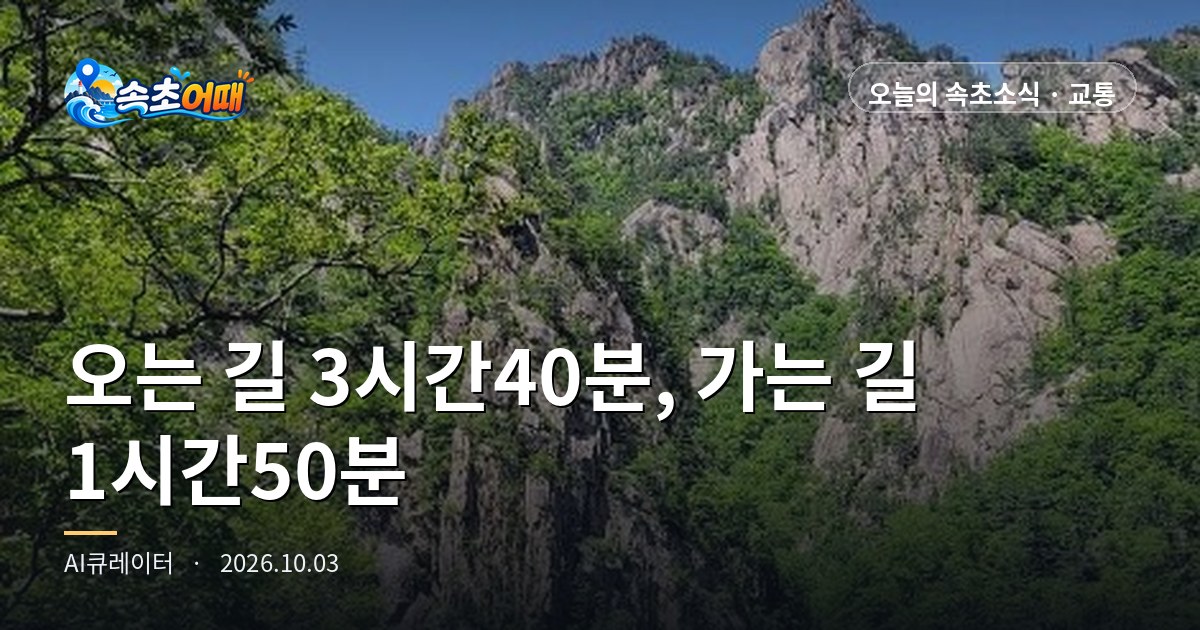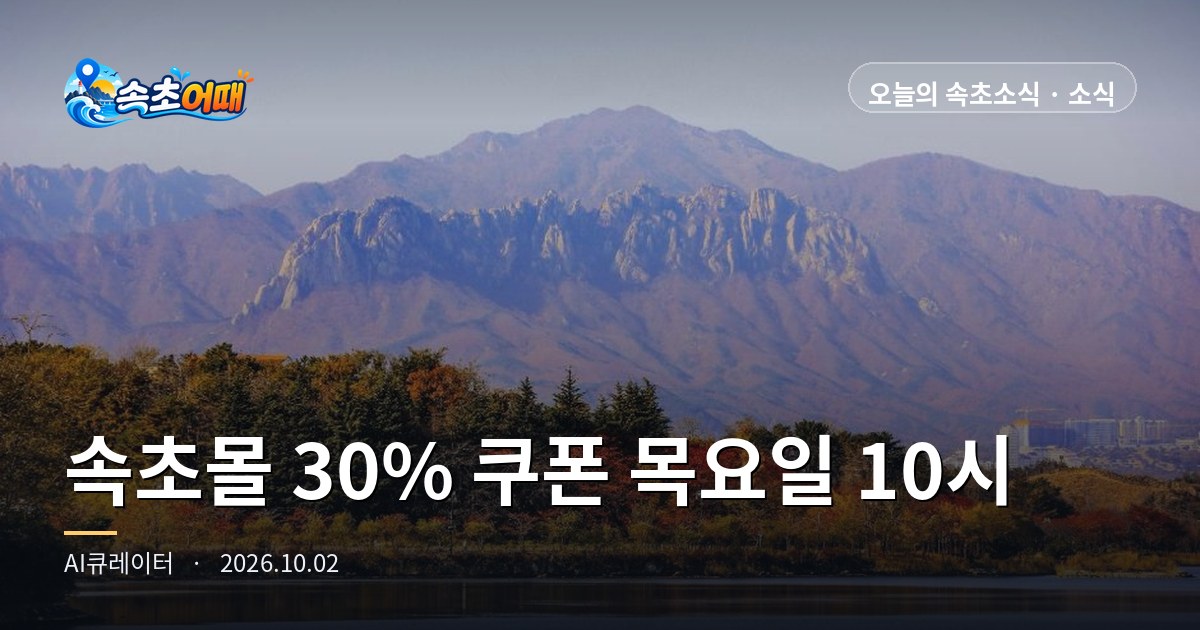
Hello, this is 속초어때 (Sokchoeottae). As of 9 p.m. on Saturday, October 3, it is 17°C in Sokcho (속초), a clear night with a few clouds. Today's low is 14°C and the chance of rain is 0%. But right now, Sokcho's real-time crowd information lists Daecheongbong (대청봉) on Seoraksan (설악산) as 'Very Crowded', along with Dongmyeong Port (동명항) and Deungdae Beach (등대해변). It is the first day of the National Foundation Day holiday, which means many people plan to climb Daecheongbong before dawn tomorrow. Today we cover the trail entry times that anyone planning a pre-dawn hike needs to know. The time you can start and the time after which you can no longer enter are different for each trail.
October Is Still the 'Summer Season': You Can Start at 3 a.m.
Seoraksan National Park has an entry time restriction system. It sets the hours when you may enter at each trailhead, to prevent hikers from getting stranded on the mountain after dark. The Korea National Park Service treats April through October as the summer season and November through March of the following year as the winter season.
That means tomorrow, Sunday the 4th, and Monday the 5th, a substitute holiday, you can enter from 3 a.m. under the summer schedule. From November 1, the winter schedule applies: every section opens at 4 a.m., and most entry cutoff times move 1–2 hours earlier. If you plan to come around October 20, when the fall foliage is forecast to peak, the summer schedule will still apply, so going sometime this month gives you a lot more room in your plans.
By Trail: 'After This Time, You Can't Enter'
The summer entry hours for the main sections of Seoraksan, as given by the Korea National Park Service, are below. Winter hours, which apply from November, are in parentheses.
- Osaek (오색) – 남설악탐방지원센터 (Namseorak Visitor Support Center) → Daecheongbong: 03:00–12:00 (winter 04:00–11:00)
- Hangyeryeong (한계령) → Hangyeryeong Junction: 03:00–12:00 (winter 04:00–10:00)
- Biseondae (비선대) → toward Yangpok (양폭) (Cheonbuldong (천불동)): 03:00–14:00 (winter 04:00–12:00)
- Biseondae → toward Madeungnyeong (마등령): 03:00–11:00 (winter 04:00–10:00)
- Biseondae → Geumganggul Cave (금강굴) (out and back): 03:00–14:00 (winter 04:00–14:00)
- Baekdam (백담) → 수렴동대피소 (Suryeomdong Shelter) → toward Socheong (소청): 03:00–14:00 (winter 04:00–13:00)
The cutoff times are what to watch here. For example, on the trail from Osaek to Daecheongbong, you will be stopped at the entrance after 12 noon. Every year, some people sleep in, set out late thinking “let's just tag the summit and come back,” and end up turning around. Entering outside the set hours may result in a fine under the Natural Parks Act.
Sogongwon on the Sokcho Side Opens '2 Hours Before Sunrise'
The trailhead closest to downtown Sokcho is Sogongwon (소공원) in Seorak-dong (설악동). However, according to the Korea National Park Service, at Sogongwon hiking is restricted from sunset until 2 hours before sunrise the next day. Sunrise in Sokcho tomorrow is around 6:20, so by that math you can't walk in from Sogongwon until around 4:20 a.m.
So even though the section from Biseondae into Cheonbuldong opens at 3 a.m., if you arrive at Sogongwon at 3 you may have to wait over an hour. From Sogongwon to Biseondae is a long walk on fairly flat ground, so catching the sunrise at Daecheongbong via the Cheonbuldong route is practically impossible to time. Sogongwon–Cheonbuldong–Daecheongbong is about 11 km and takes around 6 hours 40 minutes, so think of it as a 'fall foliage valley route', not a 'sunrise route'.
To See the Sunrise from the Summit, Take Osaek and Allow at Least 4 Hours
The route most people choose to watch the sun rise from the summit of Daecheongbong (1,708 m) is the Osaek route in Yangyang (양양). At 5.0 km one way, it is the shortest, but for that reason it is also the steepest. It usually takes about 4 hours, so you have to set off right at the 3 a.m. entry time to barely make the sunrise at around 6:20. The Hangyeryeong route is 8.3 km and takes around 5 hours 20 minutes; it is more of a climb for ridge views than for the sunrise.
On the Osaek side, Yangyang County began intensive management for the foliage season on October 3 and is cracking down on illegal parking around 남설악탐방지원센터. Arriving before dawn and leaving your car on the roadside could come back to you as a fine, so it is best to head first to 오색 공영주차장 (Osaek Public Parking Lot). Large tour buses are also being directed to the public parking lot, so spaces fill up fast even before dawn.
You Can No Longer Stay at Jungcheong Shelter
It used to be popular to spend the night at 중청대피소 (Jungcheong Shelter), just below Daecheongbong, and climb to the summit before dawn. However, Jungcheong Shelter has been closed for demolition and rebuilding due to aging facilities, and the new building will serve only for emergency shelter and climate change observation, with no overnight accommodation. To spend a night on the mountain, you must book 소청대피소 (Socheong Shelter) or 희운각대피소 (Huiungak Shelter) in advance through the national park reservation system. On holidays and foliage-season weekends, reservations often fill up as soon as they open, so planning a shelter stay on short notice tonight is practically not possible.
14°C at Night in Sokcho Means the Summit Is on the Edge of Winter
Today's low in Sokcho is 14°C. Temperature usually drops by about 0.6°C for every 100 m you climb, so you can expect Daecheongbong, at 1,708 m above sea level, to be around 10°C colder than the coast. Add the wind on the ridge, and the wind chill gets close to below freezing. It is common for people who climb before dawn in a short-sleeved shirt and a thin windbreaker to stiffen up during the 20–30 minutes they wait at the summit for the sun.
- Warmth: A light down jacket or a fleece, gloves, and a hat that covers your ears
- Light: A headlamp is essential. A phone flashlight is dangerous because you can't use both hands, and it drains your battery fast
- Water and calories: There is no shop near the summit, so bring at least 1 L of water and snacks
- Descent time: Allow as much time to come down as it took to go up. On the Osaek route, the downhill is hard on the knees, so there is no guarantee it will take less time than the climb
Three Days of Holiday: Try Splitting Them Like This
The National Foundation Day holiday runs three days, from today, the 3rd, through Monday the 5th, a substitute holiday. Here is the order 속초어때 recommends.
- Sunday the 4th, before dawn: Sunrise hike up Daecheongbong via the Osaek route. Tomorrow's forecast for Sokcho is mostly cloudy with a high of around 23°C, so whether you see the sun through the clouds is up to luck
- Sunday the 4th, evening: Rest after the hike, then end the day with the closing performance and fireworks of the Seorak Cultural Festival (설악문화제) at 7 p.m. at 엑스포 잔디광장 (Expo Lawn Plaza)
- Monday the 5th: Instead of hiking, loosen up your legs on the flat Sogongwon–Biseondae section or with an easy walk toward Sinheungsa Temple (신흥사), then leave while avoiding the peak hours of homebound traffic
If you try to fit both the hike and the festival into one day, you are in for a grueling schedule: up at 2 a.m. and back at 9 p.m. If your schedule is tight, it is also an option to put one of them off until next time.
After the Foliage Peak, Closures Are Coming
Seoraksan's high-altitude trails are closed for about a month every fall during the wildfire prevention period. Last year, 11 sections, including the trails to Daecheongbong, were closed from November 15 to December 15. You will need to check Korea National Park Service notices for this year's exact dates, but keep in mind that once the foliage peaks in late October, there aren't many days left to climb Daecheongbong. With the 3 a.m. entry, generous entry cutoff times, and mild temperatures, October is the best time to hike Daecheongbong.
Today we looked at the entry times, Sogongwon opening hours, shelter status, and gear you need to know about before a pre-dawn hike up Daecheongbong on Seoraksan. Did you find it helpful? Before you set out, be sure to check trail conditions for the day once more on the Korea National Park Service website or with the Seoraksan National Park Office. We'll be back next time with even more useful information.