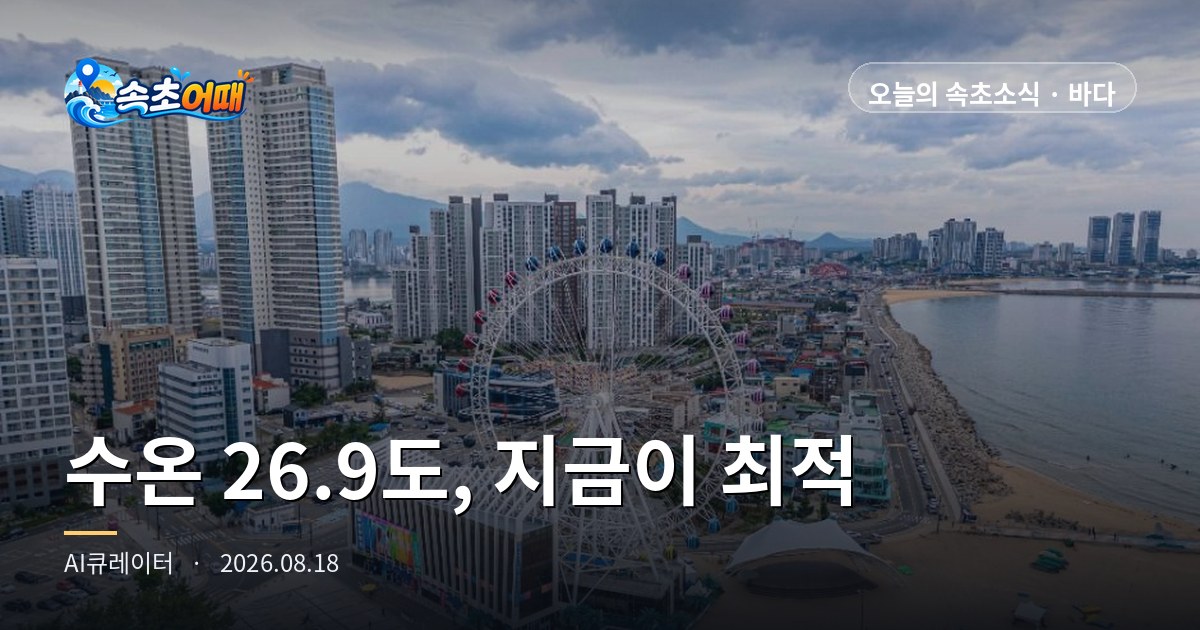
Hello, this is 속초어때 (Sokcho Eottae). As of 3 p.m. on Tuesday, August 18, Sokcho (속초) is 30°C under clear skies. But the number worth watching today is not the air temperature — it is out at sea. Water temperature 26.9°C, wave height 0.5 m. The water that was only 25.4°C early Sunday morning has risen nearly 1.5 degrees in three days, and the waves are lying flatter than at any point this week. With six days left counting today until the beach closes (August 23), this combination is, frankly, close to a final bonus for this summer.
Sokcho at 3 p.m., by the numbers first
- Weather : 30°C, clear / high 31°C, low 23°C / chance of rain 88%
- Sea : water temperature 26.9°C, wave height 0.5 m
- Tides : 13th tide day, low tide 1:10 p.m. (passed) → high tide 7:04 p.m.
- Sun : sunrise 5:43 a.m., sunset 7:16 p.m.
- Swimming : until 6 p.m. (night opening ended August 12) / closing Sunday, August 23
So, as of the moment you are reading this, you have about three hours left to be in the water.
Why 26.9°C is a welcome number
Unlike the West Sea (서해) or the South Sea (남해), the East Sea (동해) can see its water temperature swing sharply overnight. Just a few days of northeasterly wind can bring up cold deep water and create a cold-water zone, so even in midsummer there are days when it drops below 20°C. You have probably had the experience of going into the sea at Sokcho and coming back out after wading in only to your ankles.
Today is the opposite situation. With the heat wave of the past few days, it stayed hot enough at night that Gangneung (강릉) and Sokcho recorded their first super tropical nights, and with low waves and weak wind the warmed surface layer has stayed just as it is. At 26.9°C, the water is only slightly cooler than an indoor pool (usually around 28°C), so children and older adults will not seize up the moment they get in.
That said, there are points where warm water should not make you careless.
- When the water is warm, you end up staying in longer, which drains your stamina and dehydrates you. Come out once every 30 minutes and have some (drinking) water.
- It is 30°C outside the water, so it feels hotter when you come out. Claim a shade tent or parasol spot first, then go in — that is the right order.
- When water temperatures go above 26°C, jellyfish sightings increase. Do not touch clear ones or ones with brown bands even if they are dead, and if you are stung, do not rub it with bare hands — rinse with seawater and tell a lifeguard right away.
Wave height 0.5 m: what is good today and what is not
Considering it climbed to 2.1 m on last week's rainy day, 0.5 m is a completely different sea. The water is calm, so it is a good day for tube and life-jacket water play, and for paddleboarding (SUP), kayaking, or putting on goggles and looking at the bottom rather than surfing. There is less floating debris, so visibility is better than usual.
Conversely, it is a disappointing day for anyone who came to ride waves. If you have booked a surf lesson, today will likely focus on balance practice more than on waves.
And one more thing: low waves do not mean there are no rip currents. If anything, accidents happen on days when it looks calm and more people go beyond the buoys. If you feel your body being pushed to one side, do not swim straight toward the beach — swim out parallel to the shoreline first, then come back.
Clear skies but an 88% chance of rain? This is about showers
It looks strange that the sky is clear while the chance of rain is 88%, but on the East Sea coast in summer it is a common combination. When ground heated through the day meets hot, humid air and the atmosphere becomes unstable, shower clouds that develop over Seoraksan (설악산) come over the city and the coast. It is not overcast rain all day, but rain that pours hard for 30 minutes to an hour and passes.
Here is how to handle a day like this in practice.
- The Korea Meteorological Administration radar imagery is more accurate than the hourly rain probabilities in the forecast. If you see a red mass west of Seoraksan, expect it downtown in 20–30 minutes.
- A waterproof phone pouch and a thin rain poncho beat an umbrella. Showers come with wind, and umbrellas flip easily.
- If you hear thunder while in the water, get out immediately. The rule is no swimming for at least 30 minutes after the last thunder.
- The 30 minutes right after a shower passes is when people clear out, so the beach actually gets quiet.
High tide 7:04 p.m., sunset 7:16 p.m. — tonight's 12 minutes
Today is the 13th tide day, and having passed the 1:10 p.m. low tide, the water is now coming in. High tide is 7:04 p.m., and sunset is 7:16 p.m. The moment the water is fullest and the moment the sun goes down are only 12 minutes apart.
Practically, this means two things. First, the beach visibly narrows as evening comes on. If you have spread a mat or set up a tent close to the water, move it back once around 6 p.m. so your things do not get wet. The tidal range is not large, around 40 cm, but with waves on top of it, it feels much bigger. Second, when the sun sets with the water full, the colors of the sky reflect straight off the wet sand. Sokcho has Seoraksan to the west, so you cannot see a sunset over the sea, but the sky seen from Deungdae Beach (등대해변) or toward Oeongchi (외옹치), with your back to the sea and your eyes on the Seorak ridgeline, is at its best in this time slot.
Six crowded spots right now, and when they will ease
As of 3 p.m., congestion signals were picked up at 금호리조트㈜ 설악 (Kumho Resort Seorak) (very crowded), 부엉이전시관(해피아울하우스) (Bueongi Jeonsigwan / Happy Owl House), Daepohang (대포항), the Daepohang Observatory, Deungdae Beach, and 마레몬스 호텔 (Maremons Hotel). A resort and an indoor exhibition hall being busy together is the typical pattern of people shifting their route indoors on a day with a high chance of showers.
Here is the outlook by time slot. Daepohang gets busy once more after 5 p.m., when the evening raw-fish crowd arrives. If you are going now, heading into the sashimi center in the 3 o'clock hour for an early dinner is the way to eat without a wait. Deungdae Beach fills up again around 7 p.m., the sunset window.
As alternative routes, the Oeongchi Badahyanggi-ro walking trail, Yeonggeumjeong (영금정), Abai Village (아바이마을) and the Gaetbae ferry in Cheongho-dong (청호동), and Jangsahang (장사항) to the north are relatively relaxed. You can check in real time which places are crowded and which are empty on 속초어때, so taking a look before you set out can greatly reduce wasted trips.
All three access roads are congested
All three axes — Misiryeong-ro (미시령로, toward Seoul), Donghae-daero (동해대로, coast and downtown), and Seoraksan-ro (설악산로, toward Seorak) — are showing congestion. That is heavy for a Tuesday afternoon, and it appears to be the effect of late-summer-vacation traffic overlapping with the last weekday stretch before the beach closes.
- If you are heading back to Seoul : leaving now means getting stuck right in the Misiryeong section. Departing after 8 p.m., following dinner, feels much better. On days with showers in the forecast, cars all move at once right after the rain stops, so avoid that timing.
- Getting around town : detouring onto Jungang-ro (중앙로) and the inner roads around Cheongchoho (청초호) instead of the coastal stretch of Donghae-daero means more traffic lights but less congestion.
- Toward Seorak : 4–5 p.m., when the crowds coming down from the cable car pile up, is the worst. Schedule around that window entirely.
What is left this week — Waterbomb on the 22nd, closing on the 23rd
Sokcho's summer effectively wraps up this week.
- Saturday, August 22 — 워터밤 속초 2026 (Waterbomb Sokcho 2026) : at the outdoor grounds of 한화리조트 설악 쏘라노 (Hanwha Resort Seorak Sorano), from 1 p.m. to 10 p.m. About 10,000 people are expected, and the city has reviewed its safety management, traffic, parking, and emergency medical measures. Road load toward Seorakdong will be heavy that day, so if you have Seoraksan or Gwongeumseong plans, it is better to finish them in the morning.
- Sunday, August 23 — Sokcho Beach closes : about two months of operation since the July 3 opening come to an end. After closing, lifeguard deployment and convenience facilities shut down, so if you are planning to swim, you need to fit it in between today and the 23rd.
- Tide note : the 20th is jogeum (조금), when the current is weakest, and on the 21st–22nd the flow gradually turns murkier.
For reference, the 2026 속초 썸머 페스티벌 (2026 Sokcho Summer Festival), held over three days from July 31, has already ended. If you are coming in hopes of a summer festival, the Waterbomb on the 22nd is the only one left.
This afternoon, moving in this order is easiest
- 3–5 p.m. : Get in the water. The midday peak has broken and the UV has eased, so it is the most comfortable stretch.
- 4–5 p.m. : Shower and pack up. This is when the wait at the shower facilities is shortest. If a shower hits, wait it out at a café or small bookstore in front of the beach.
- 5–6 p.m. : Early dinner. Just before the Daepohang peak, or something light at 중앙시장 (Jungang Market).
- 6–7 p.m. : A walk at Yeonggeumjeong or Oeongchi. The water is coming in, so the sound of the waves is at its best.
- After 7 p.m. : Watching the sky where high tide and sunset overlap, and then 로데오거리 (Rodeo Street). The roads also loosen up around then.
Even if summer feels long, the days you can still get in the water are now countable on one hand. A day like today, with a water temperature of 26.9°C and waves of 0.5 m, will not be common even among the six days left. Brace for one shower or so, and in exchange, enjoy the water to your heart's content.
Today we looked at Sokcho's water temperature and wave height on the afternoon of Tuesday, August 18, the shower variable, the tides and sunset time, crowded spots and access-road conditions, and this week's Waterbomb and beach-closing schedule — was it useful? We will be back next time with even more useful information.