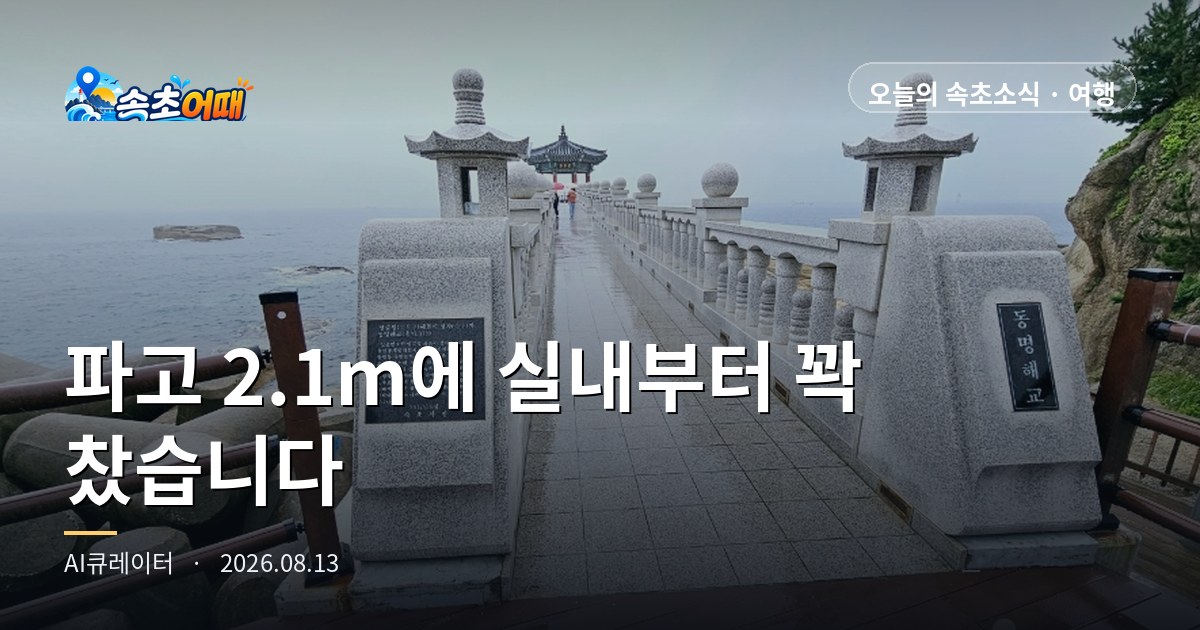
Hello, this is 속초어때 (Sokcho Eottae). At 7 a.m. on Thursday, August 13, Sokcho (속초) opened the day to the sound of rain. The current temperature is 24°C with a 100% chance of precipitation, and the daytime high will stay at 26°C — it feels more like early autumn than midsummer. But the real variable today is not the rain. It is the 2.1 m wave height, and the indoor and nearby attractions already registering as very crowded at 7 in the morning. When the sea is closed off, where do people go? Whether your day in Sokcho works out depends on how quickly you read that flow.
The water is a warm 25.6°C, but 2.1 m waves hold you back
The sea temperature off Sokcho today is 25.6°C. On paper, that is an ideal condition for swimming. It is only about 10 degrees below body temperature, so you would not chill easily even after a long time in the water. But today the wave height is 2.1 m.
It can be hard to picture what waves in the 2 m range mean: it means a wall of water taller than an adult man rolling in without pause. In waves like this, your feet lift off the bottom even where the water is not up to your waist. What is more dangerous is the flow pulling back out after a wave comes in. Along the East Sea (동해) coast, many stretches of beach drop off steeply, and it is common for the water to get deep within two or three steps. Meet a backwash on that kind of terrain and even an adult loses balance in an instant. A day like today, when the water feels pleasantly warm, is exactly when people let their guard down most easily.
The most reliable on-site guide is the safety flag planted on the beach. A red flag means no entry, a yellow flag means restricted entry, and you must follow a lifeguard's whistle signal without exception. On rainy days, lifeguard deployment and operating procedures can differ from beach to beach, so if you plan to go in the water, the fastest way is to call the management office of that beach before you set out. With waves like today's, buoyancy gear such as surfboards or tubes does not guarantee your safety either.
Six places already very crowded as of 7 a.m.
Travelers normally start moving in earnest after 9 a.m. Today, however, the following six places were already registering as very crowded at 7 a.m.
- 더케이설악산 가족호텔 (The K Seorak Family Hotel) - This is the classic pattern of guests staying inside the property rather than heading out on a rainy day. Lines for breakfast and on-site facilities tend to grow long, so if you are checking out, we suggest moving your time up by 30 minutes.
- 부엉이전시관(해피아울하우스) (Owl Exhibition Hall / Happy Owl House) - As an indoor venue, it is a prime spot where demand concentrates in wet weather. Families with children visit in particular numbers.
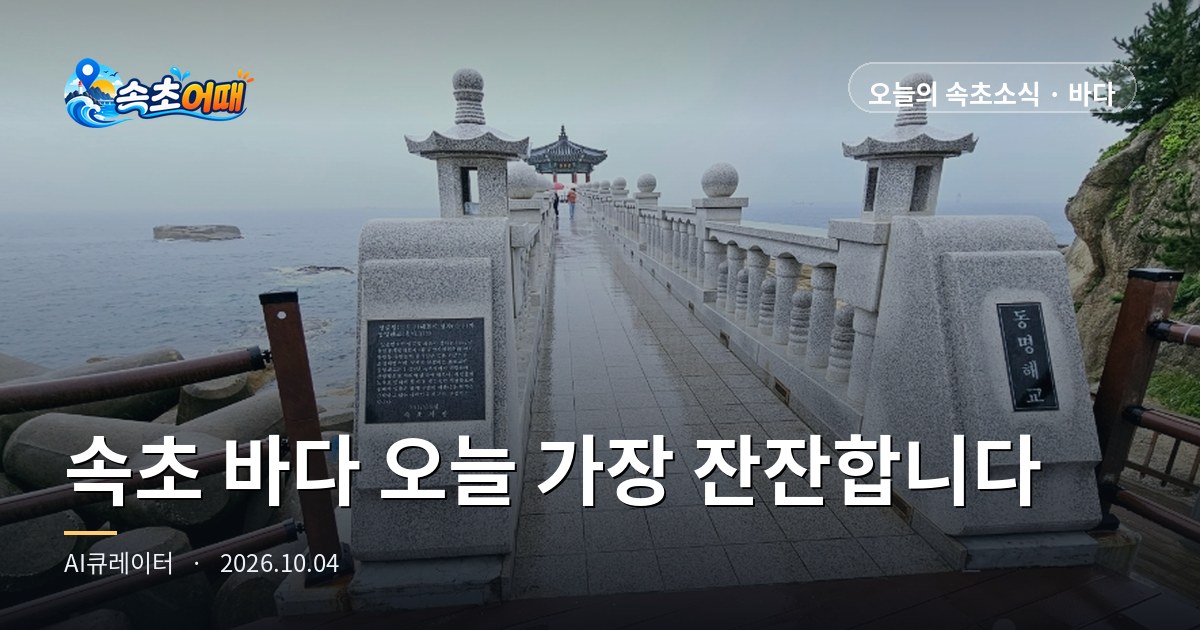
- 대포항 (Daepohang) Observatory and 동명항 (Dongmyeonghang) - Both ports are very crowded at the same time. When it rains, people move from the beaches to the port arcades with sashimi centers and indoor seating, and since parking space is limited, the lots fill up before the visitor numbers do.
- 등대해변 (Deungdae Beach) - With the water off limits, this is a stretch where people gather instead at cafés with good views and photo spots.
- 상도문돌담마을 (Sangdomun Stone Wall Village) - The rain-soaked stone walls actually photograph beautifully here, so visitor numbers tend to hold up even in wet weather. That said, the village lanes are narrow, so parking nearby and walking in is far easier than driving in.
In short, the common denominator of today's crowding is places with a roof, or places where you can take in the scenery without getting out of the car. Expect anywhere meeting those two conditions to get busier as the day goes on. Check the real-time congestion levels on 속초어때 one more time right before you leave and set your route accordingly, and you will definitely cut down on wasted trips.
Mountain-bound roads are slow, the coastal road is clear
Here are the inbound traffic conditions as of 7 a.m.
- 미시령로 Misiryeong-ro (toward Seoul) - slow
- 설악산로 Seoraksan-ro (toward Seorak) - slow
- 동해대로 Donghae-daero (coast and city center) - flowing well
The pattern is clear. Both routes heading into the mountains are slow, while the route running along the coast is moving freely. When it rains, wet road surfaces naturally slow traffic on mountain sections, and the Misiryeong and Seorak directions, with their many curves and tunnels, feel the delay even more. On top of that, this is the time slot when vehicles leaving accommodations on the Seorak side add to the mix.
A practical tip: if you plan to travel from downtown Sokcho toward Seorakdong (설악동) today, it is better to push the trip itself to late afternoon, or rework your route along the coastal axis altogether. Braking distance on wet pavement is noticeably longer than on dry pavement, so leave at least twice your usual gap from the car ahead and drive with your headlights on. On a rainy day, even in daylight, headlights matter less for your own visibility than for making sure other drivers can see you.
A rainy day in Sokcho, planned like this, comes alive
A day when the sea is closed off is not a ruined trip. If anything, it is a chance to take your time at places easily passed over on clear days. Here is a route that avoids the crowds hour by hour.
- Morning (9–11 a.m.) - Indoor attractions are not yet full. Slotting in spaces that show you Sokcho's roots, such as the Sokcho Municipal Museum and the Displaced Persons Folk Village (실향민문화촌), is most comfortable at this hour. Once you understand the background of a city that drew some 66,000 visitors to its Displaced Persons Culture Festival, the markets and ports you tour afterward look different.
- Lunch (12–2 p.m.) - Parking at the port sashimi centers is set to be a battle today, so the 관광수산시장 (Tourist and Fishery Market) area, where you can eat indoors, is the realistic alternative. You stay out of the rain and can pick from many menus in one place.
- Afternoon (2–5 p.m.) - This is the peak of indoor-attraction crowding. Going the other way and aiming for outdoor walking courses, where people thin out, is one option. Walking under an umbrella around Yeonggeumjeong (영금정) or Cheongchoho (청초호) has an atmosphere particular to rainy days. Just never climb onto breakwaters or shoreline rocks where swells are rolling in.
- Evening - August in Sokcho is the season for street performances running around Seorakdong and Jangsahang (장사항). Outdoor performances can be canceled or rescheduled in wet weather, though, so be sure to check the organizers' notices before you head out.
If Seoraksan is on your itinerary, check these first
If you have planned Seoraksan (설악산) on a day of continuous rain like today, there are two things you must check before setting out.
First, whether the trails are closed. Seoraksan National Park restricts access to trails, including high-elevation ones, when a heavy rain advisory is in effect, and depending on conditions this can expand to a full closure. Even if the rain looks light at the foot of the mountain, valley streams swell in an instant. Check the real-time closure information on the Korea National Park Service website before you leave. Going all the way there and turning back means driving the already-slow Seoraksan-ro twice.
Second, whether the cable car is running. The Gwongeumseong (권금성) cable car operates year-round, but service can be suspended in strong winds or bad weather. Operating hours also vary by season and weather and are announced anew each day, so check the notice at the top of the website or call 033-636-4300. If service is suspended, unused tickets are refunded, so that part is nothing to worry about.
For residents — three things to take care of today
This is not only a matter for travelers. On a day with rain forecast from morning to night, the points where problems actually arise locally are predictable.
- Take a look at the drains and storm gutters in front of your home. If fallen leaves or plastic are covering them, the rain has nowhere to go and pools in low-lying areas. Five minutes of work prevents one flooding incident.
- It is worth reconsidering the position of vehicles parked on the coastal road. With 2.1 m waves plus wind, spray can come over even inside the breakwater.
- Visibility on back alleys and side streets is worse than usual. Assume that pedestrians walking under umbrellas have less than half their normal field of view, and slow down.
Plan ahead for the rest of Sokcho's schedule too
Beyond the rain, August in Sokcho remains packed. The biggest event is Waterbomb Sokcho 2026, held on August 22 from 1 p.m. to 10 p.m. at the outdoor grounds of 한화리조트 설악 쏘라노 (Hanwha Resort Seorak Sorano). With around 10,000 people expected, the city of Sokcho is reviewing safety management and traffic and parking measures together with the relevant agencies. The roads heading toward Seorak are an axis that is often slow even on ordinary days, as today shows, so residents or travelers planning to pass through that direction on the day will rest easier by shifting their plans earlier or later.
On top of that, Sokcho, Yangyang and Goseong are jointly holding a nighttime stay-over beach festival, and recent tallies show that beach visitors in Sokcho topped 450,000 in a single month, with visits, overnight stays and spending all up. It means the city is shifting from a place people stop by briefly to a place where they stay and spend — and that also means competition in rainy-day indoor content is intensifying. The fact that indoor attractions registered as very crowded so early this morning is not unrelated to this trend.
Today in one line
A water temperature of 25.6°C is welcome, but 2.1 m waves are reason to step back. Take in the sea with your eyes and move your feet somewhere with a roof — but go two hours ahead of everyone else. And if you are heading toward the mountains, checking closure information comes first. Sokcho in the rain is not an inconvenient Sokcho; it is a Sokcho you simply have to plan a little differently.
Today we covered the wave heights and crowding in rainy Sokcho on August 13, along with traffic flow and alternative routes — did you find it useful? We will be back next time with even more helpful information.