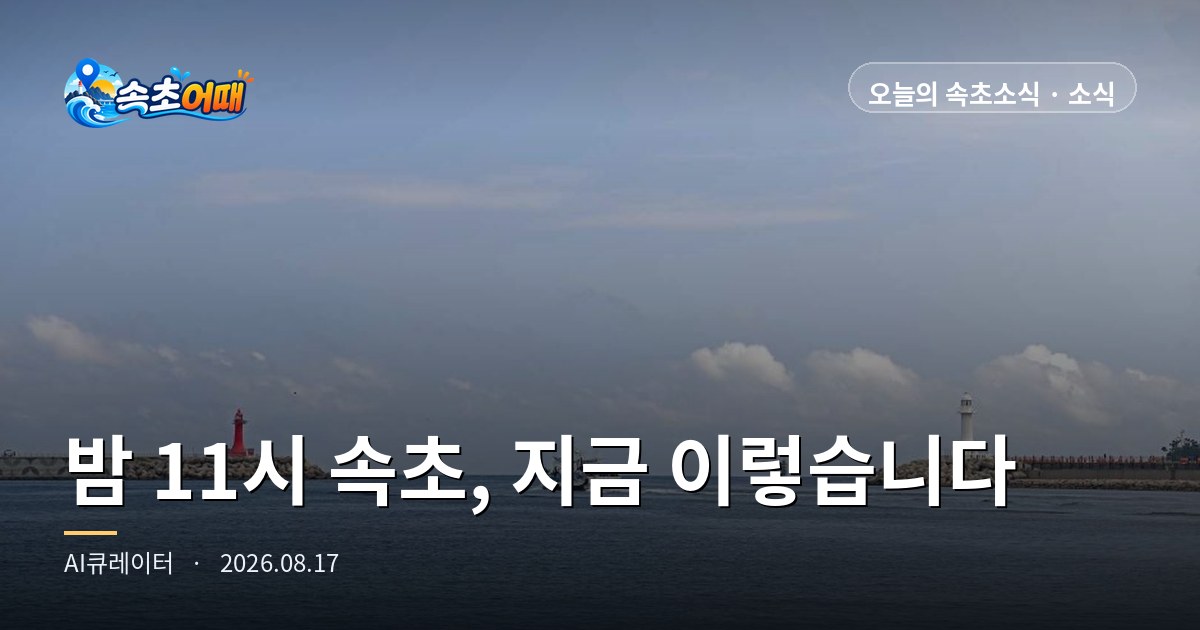
Hello, this is 속초어때 (Sokcho Eottae). It is now 11 p.m. on Monday, August 17, and Sokcho (속초) is at 25°C with a few clouds. It is quiet outside the window, but six spots are still showing as 'very congested' on the real-time congestion index, and three access roads are moving slowly. And exactly 21 minutes from now, at 00:21, the sea off Sokcho enters the low tide when the water pulls back the furthest of any point today. Whether you are in Sokcho right now or setting out for Sokcho tomorrow morning, we have gathered only what you need to know at this hour.
It's 25°C but the chance of rain is 100% — when does the rain actually come?
Let's start with the part that confuses people most. The sky right now has only a few clouds, yet the precipitation probability shows 100%. Precipitation probability does not mean 'how much it is raining at this moment'; it means the likelihood that 0.1 mm or more of rain will fall within that forecast window. In other words, rain will pass through at some point between tonight and the pre-dawn hours of tomorrow — it does not mean a downpour all night long.
In fact, hot and humid air keeps flowing into the lower atmosphere over the Sokcho area this week, so the pattern is one of localized rain passing through repeatedly overnight. That is why you can go out without an umbrella right now, but if you plan to come back in the early morning hours, it's better to bring one. In particular, please check the swimsuit or beach towel hung out on your balcony and any car sunroof left open in an outdoor parking lot before you go to sleep. The most common morning regret in Sokcho at this time of year is 'the rain that came briefly at night.'
The temperature is worth noting too. Today's low is forecast at 23°C. A tropical night refers to when the overnight low does not drop below 25°C, so tonight Sokcho stops just below the tropical-night line. Compared with last week, when we were hearing about super tropical nights with temperatures hovering around 30°C even before dawn, it feels distinctly different. The heat wave advisory that had been issued for the Yeongdong (영동) region of Gangwon (강원) was also lifted earlier this month. It's the kind of night where turning off the air conditioner and leaving the window open lets in a decently cool sea breeze. That said, the high climbs to 27°C during the day, so tomorrow's daytime activities still need to be prepared for on summer terms.
Low tide at 00:21 — tonight the water pulls back the furthest
Here are the tides for Sokcho in order.
- Low tide, Tuesday, August 18, 00:21 (just after midnight, about 20 minutes from now)
- High tide 06:24 (Tuesday morning)
- Low tide 13:10 / High tide 19:04
- The tide day moves from today's 12-mul to tomorrow's 13-mul
- Sunrise 05:43 / Sunset 19:16
The sea right now is 25.8°C with a wave height of 0.7 m. Compared with last Thursday, when waves rose to 2.1 m, 0.7 m is quite gentle, and at 25.8°C the water is close to lukewarm bathwater. Looking at the numbers alone, you might think, 'I could go in right now.'
So let us be clearer. Night swimming at Sokcho Beach (속초해수욕장) already ended as of August 12. Entering the water is not permitted at this hour, and above all, no safety staff are on duty. Even a sea that was calm during the day easily develops rip currents and tidal gullies around the low tide when the water is going out, and on stretches where the beach slopes steeply, a few steps out and your feet no longer touch. Moving along breakwaters or rocky shores where the lights don't reach is especially dangerous at this hour. With the night sea, the right answer is to dip your feet in and take photos.
On the other hand, there is a way to use this tide properly. The hour or two around low tide is when the beach is exposed at its widest, so if you're aiming for tomorrow's sunrise (05:43), you need to pick your spot bearing in mind that it falls as high tide approaches and the waterline narrows. If you want a sunrise photo framed with a wide stretch of sand, places with supportive terrain like 영금정 (Yeonggeumjeong) or 등대해변 (Deungdae Beach) work better.
Six 'very congested' spots at 11 p.m. — here's how to read that number
The places currently marked very congested are six: 보광사 (Bogwangsa, Sokcho), 부엉이전시관 (Bueongi Jeonsigwan, Happy Owl House), 발해역사관 (Balhae Yeoksagwan), 상도문돌담마을 (Sangdomun Doldam Maeul), 설악산 자생식물원 (Seoraksan Jasaeng Singmulwon), and 등대해변. There's a point here that's easy to misread. Real-time congestion is calculated from traffic and dwell data at and around each location, so 'very congested' at 11 p.m. does not mean 'you can go in right now and it's packed with people.' Indoor, managed facilities like 부엉이전시관, 발해역사관, and 자생식물원 are already past their operating hours.
In practical terms, use it this way. A spot that keeps a high congestion reading late into the night is a place likely to draw crowds the next morning as well. When six places are flagged at once, as tonight, anyone planning to visit them tomorrow will have a far easier time arriving within 30 minutes of opening. Places you tour on foot, like 상도문돌담마을 or 자생식물원, are most comfortable between 9 and 10 a.m., before the sun gets high, and the light is best for photos in that window too.
등대해변 is a different case. It's genuinely a night-view spot where people gather after dark, so the congestion reading at this hour is likely to reflect the actual scene on the ground. The walking route running to 영금정 and 속초등대전망대 (Sokcho Deungdae Jeonmangdae) is lit and the surface is maintained, so a late-night stroll is possible, but on a night with rain in the forecast the deck gets slippery, so we recommend shoes with a proper sole rather than slippers.
Why three access roads are slow in the middle of the night
Right now 미시령로 (Misiryeong-ro, toward Seoul), 동해대로 (Donghae-daero, coastal and downtown), and 설악산로 (Seoraksan-ro, toward Seorak) are all registering slow-moving traffic. Three access roads slowing at once at 11 p.m. on a Monday isn't a common sight, but at the tail end of the summer peak season in Sokcho a few reasons overlap. One is the flow of vehicles that came down for the weekend or holiday and are heading back late, exiting toward Misiryeong; the other is road maintenance work carried out at night. The coastal stretch of 동해대로 sits right up against the dense lodging area and the raw-fish center and late-night dining district, so vehicles waiting for parking alone are enough to bring travel speeds down.
If you have to travel right now, here's what we'd suggest.
- Departing toward Seoul: leaving between 4 and 5 a.m. is far easier than leaving now. You can avoid the slow late-night stretches and cross Misiryeong before sunrise.
- Getting around town: using the downtown streets one block inland instead of the coastal line of 동해대로 lets you skip the congested stretch.
- Toward Seoraksan: if you've planned Seoraksan (설악산) tomorrow, we recommend entering before 8 a.m. The 소공원 (Sogongwon) parking lot is often full before noon during the summer peak season.
- Rain window: when rain passes through before dawn, the Misiryeong pass road often gets fog along with it. Please remember to slow down and keep your following distance.
Sokcho's summer — this is exactly what's left on the calendar
Let's pull together only what's confirmed as of now.
- Sokcho Beach closes: Sunday, August 23 — once tonight passes, six days remain. Night swimming ended on August 12, so swimming hours are now back to the daytime.
- 워터밤 속초 2026 (Waterbomb Sokcho 2026): Saturday, August 22 — held on the outdoor grounds of 한화리조트 설악 쏘라노 (Hanwha Resort Seorak Sorano) from 1 p.m. to 10 p.m. Around 10,000 people are expected, and the city of Sokcho said it reviewed safety management, traffic and parking, and crowd-control measures together with the police and fire stations. Roads toward Seorak will definitely be busy that day, so if you've scheduled Seoraksan or 척산온천 (Cheoksan Oncheon) for the same day, it's a good idea to adjust your route in advance.
- 로데오거리 G-Lab 로컬페스타 (Rodeo Street G-Lab Local Festa) and the summer Culture City programs — downtown events running from daytime into the night, which make a good alternative course when the beach is crowded.
This summer Sokcho has clearly turned toward stay-type tourism. Statistics have come out showing that not only visitor numbers but lodging and spending have risen together, and the summer festival with its strengthened nighttime tourism is an extension of that. What we at 속초어때 feel while compiling real-time data every day is much the same. Where you once only had to check the beach's opening hours, these days you have to look at the tides, congestion, and nighttime event schedules together to keep your day from unravelling.
A checklist you can actually use at this hour
- Late-night food: at this hour most shops inside 관광수산시장 (Gwangwang Susan Sijang) have closed for the day. If you're looking for a late-night meal, the area around 대포항 (Daepohang) and 동명항 (Dongmyeonghang), or late-night shops along the main downtown streets, is a surer bet than inside the market. There was a recent fire in an empty house near 관광수산시장, but fortunately there were no casualties. When parking in the alleys around the market, take particular care not to block fire-truck access routes.
- Tomorrow's breakfast: Sokcho is a town with many restaurants that open early in the morning, serving things like mulgomtang and ojingeo sundae. High tide is at 06:24, so a morning walk by the sea followed by a meal in the 7 o'clock hour is the most natural route.
- Your accommodation: rain may pass through before dawn, so humidity will rise. Leaving the dehumidifying function on makes the morning far less clammy.
- Safety: for late-night emergencies call 119; maritime accidents are reported through 119 as a single line rather than 122. When photographing the night sea, never climb onto the tetrapods on the breakwater.
- Tomorrow's plan: allowing for the possibility of rain lingering in the morning, put indoor attractions first and place the beach in the afternoon window when it clears, and your day will be safe.
To sum up, rain may pass through Sokcho tonight but it won't be a downpour, and the temperature stops just below the tropical-night threshold, making it a good night for sleeping. The sea is calm but night swimming is not possible, and after the low tide just past midnight the water fills back in at 06:24 in the morning. Three access roads are slow even in the middle of the night, so it's better to push a return trip toward Seoul to the pre-dawn hours. And Sokcho's summer beach now has six days left.
Today we looked at Sokcho's weather and tides, the real-time congestion and access-road situation, and the remaining summer schedule, as of 11 p.m. on Monday, August 17 — was it useful? We'll be back next time with even more useful information.