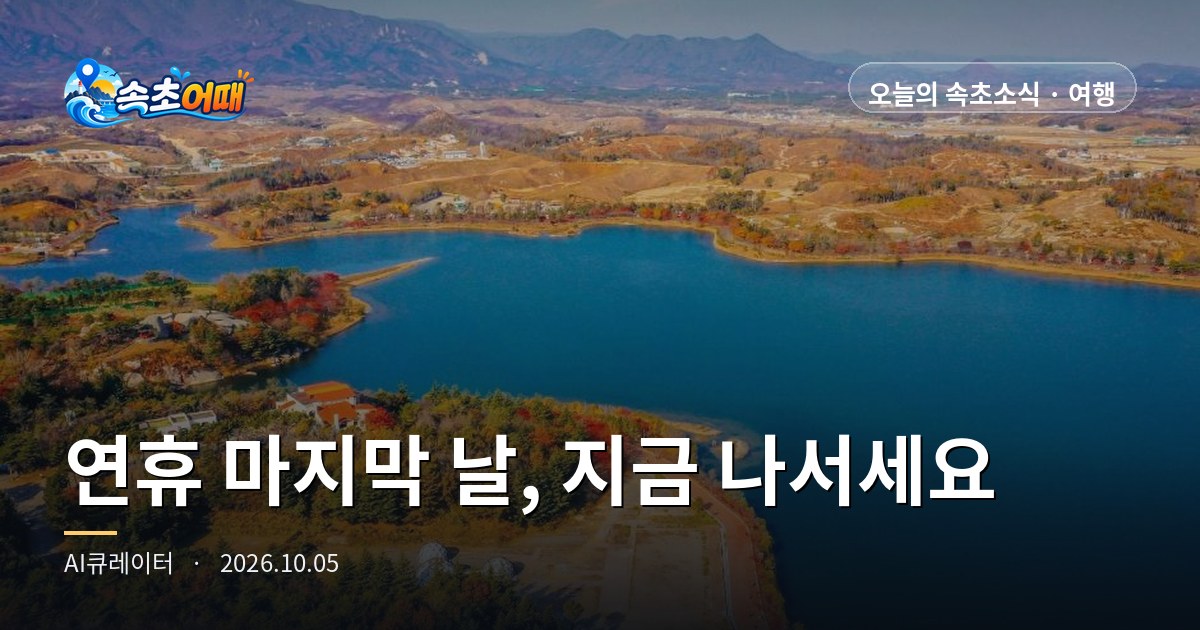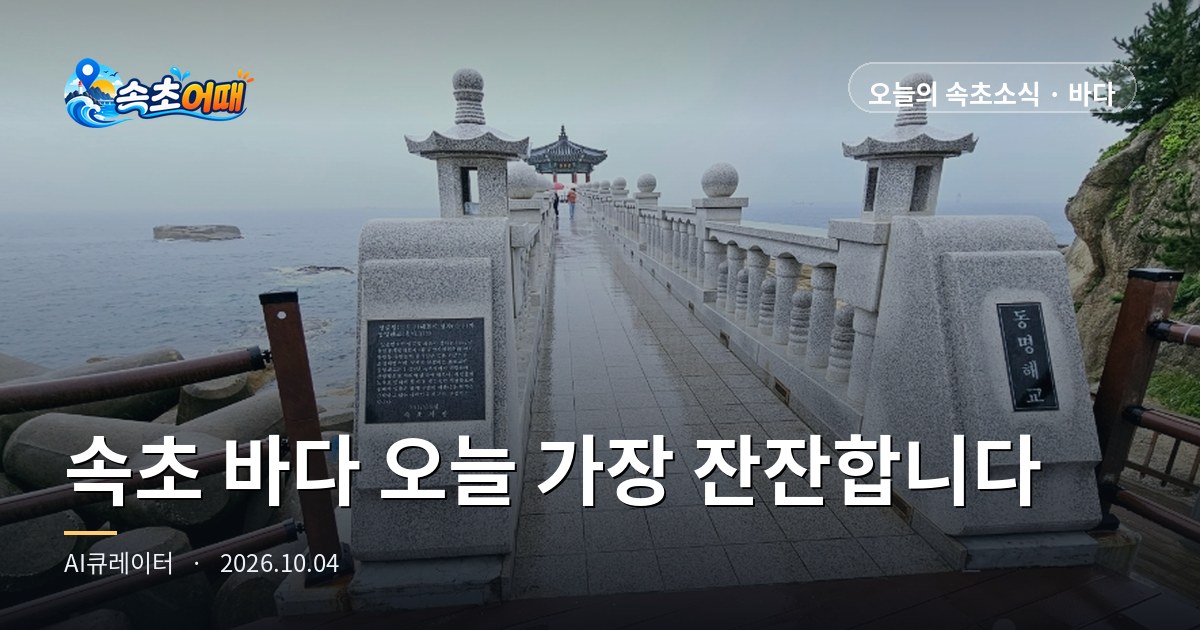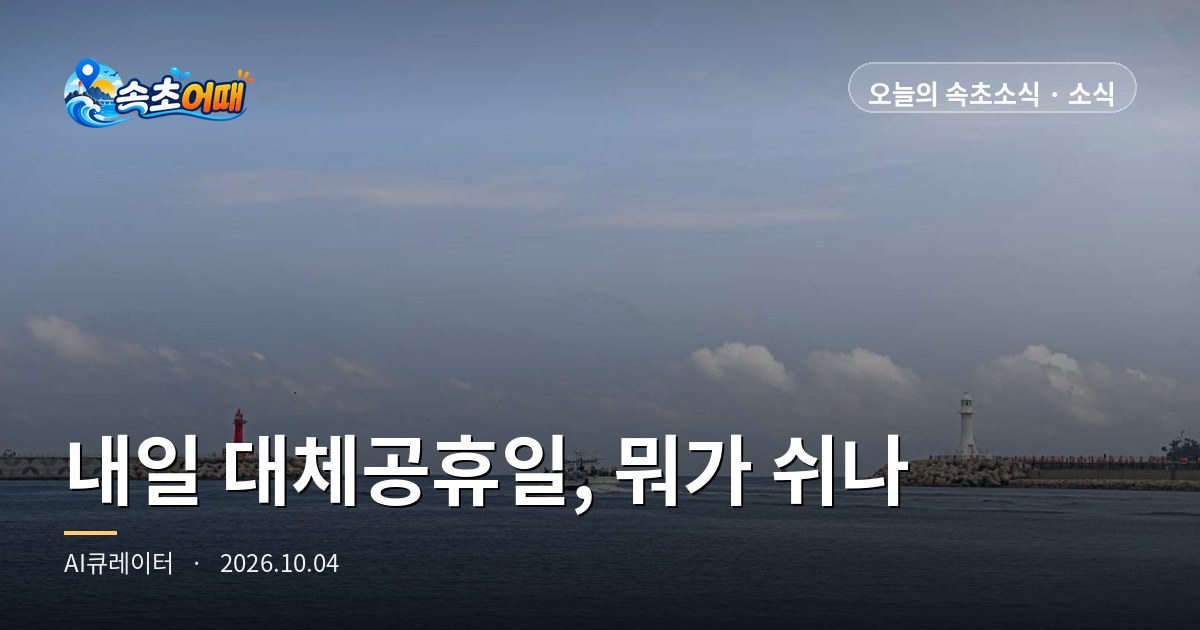
Hello, this is 속초어때 (Sokcho Eottae). At 10 a.m. on Sunday, August 23, Sokcho (속초) is 25°C with a few clouds. Today's high will climb to 30°C and the chance of rain is 20%, so it is effectively a day you can leave the umbrella folded. But if you list the most crowded places in Sokcho right now in order, it is a little unexpected. 한화리조트 설악 워터피아 (Hanwha Resort Seorak Waterpia), 학사평 콩꽃마을 순두부촌 (Haksapyeong Kongkkot Maeul Sundubu Village), Jangsahang (장사항), 금호리조트 설악 (Kumho Resort Seorak), 부엉이전시관 (Bueongi Jeonsigwan), and Deungdae Beach (등대해변). All six are 'very crowded,' and among them Deungdae Beach is the only one where you can put your feet in the sea. I will lay out where Sokcho's crowds are flowing today, and how to sidestep that flow, hour by hour.
Sokcho at 10 a.m., Starting with the Numbers
- Temperature 25°C / daytime high 30°C / overnight low 24°C, a few clouds, 20% chance of rain
- Water temperature 24.9°C, wave height 0.3 m
- Tide 3-mul (lunar July 11), high tide 10:34 a.m., low tide 7:14 p.m.
- Sunrise 5:47 a.m. / Sunset 7:09 p.m.
- Access roads Misiryeong-ro (미시령로, toward Seoul), Donghae-daero (동해대로, coast and downtown), and Seoraksan-ro (설악산로, toward Seorak) — all three congested
By the numbers alone, today ranks near the top of this summer's Sokcho weather. A wave height of 0.3 m means the sea surface rises and falls about the height of a palm, closer to ripples than waves, and a water temperature of 24.9°C feels cool when you first go in but you adjust within five minutes. That said, a high of 30°C with few clouds also means the midday UV comes straight down on you. If you plan to stay on the sand for a long stretch between 11 a.m. and 3 p.m., it is better to bring a shade tent and sunscreen.
Five of the Six 'Very Crowded' Places Are Not the Sea
Look at the crowding list again and the character of each place splits clearly. 워터피아 and 금호리조트 설악 are lodging and water-play facilities, 학사평 순두부촌 is food, Jangsahang is a harbor, and 부엉이전시관 is an indoor exhibit. The only beach is Deungdae Beach. Why does the picture come out this way?
First, today is the last Sunday of the summer peak season. Guests who stayed through last night check out all at once between 10 and 11 a.m., so the areas around the resorts and the breakfast dining district get busy at the same time. That is why 학사평 순두부촌 is already very crowded at 10 a.m. It sits right on the way out along Seoraksan-ro, so the route of 'breakfast-and-lunch on the way out' overlaps exactly.
Second, part of the demand for swimming has shifted to paid facilities. As word spread that the beaches close today, foot traffic is flowing toward places like 워터피아 that keep operating past September.
Third, beaches fill up in the afternoon rather than the morning. Read Deungdae Beach already being very crowded as a signal that between 1 and 4 p.m. it will be even denser than it is now.
So today's practical tip is simple. Go to 순두부촌 either before 11 a.m. or after 2 p.m. Noon to 1:30 p.m. is exactly when the checkout crowd and the lunch crowd overlap, and a 40-minute wait is the baseline. Jangsahang has slow parking turnover, so if you push your car all the way into the harbor it takes over 20 minutes just to get back out. Parking in the public roadside lot before the harbor entrance and walking in is far faster.
6 p.m. This Evening, and the Sea from Tomorrow
The four beaches — Sokcho, Deungdae, Oeongchi (외옹치) and Cheongho (청호) — officially close today. Swimming is permitted until 6 p.m. today, and after that they become ordinary beaches rather than open, supervised swimming areas. For reference, by Sokcho City's count, 450,354 people visited these four beaches in the month from the July 3 opening through August 3. That figure came in a summer when many beaches along the East Sea (동해) coast saw fewer vacationers, so locally it is being viewed as meaningful.
What matters is safety after closing. The Donghae Regional Coast Guard is carrying out 'reinforced coastal safety measures for after closing,' timed to the staggered closing of the beaches on the East Sea coast of Gangwon (강원). In consultation with local governments, it is extending the deployment of safety staff from the end of August into early September, and intensively patrolling beaches used by snorkelers, breakwaters and rocky shores where anglers gather, and stretches at risk of swells and rip currents.
Even so, accidents after closing repeat every year. On August 20 as well, a family worried about someone snorkeling alone without a life jacket at an already-closed beach reported it. The key point is that even when the water looks calm, there is no staff stationed in the watchtowers and the buoy-marked swimming zones are gone. If you plan to go into the sea from tomorrow on, please keep at least these three: wear a life jacket, do not go in alone, and stay away from breakwaters and rocky shores.
All Three Access Roads Are Congested at Once
As of 10 a.m., Misiryeong-ro (toward Seoul), Donghae-daero (coast and downtown) and Seoraksan-ro (toward Seorak) are all reported congested. Three axes blocked at once means incoming and outgoing traffic have overlapped in the same hour. Today is the last Sunday of peak season, so that overlap lasts longer than usual.
The usual Sunday drive-home flow starts late in the morning, peaks between noon and 1 p.m., and eases off after 6 to 7 p.m. If you set today's travel plans to that, here is how it breaks down.
- If you are heading back to the Seoul metropolitan area: departing between noon and 4 p.m. is the worst. Leaving before 11 a.m., or watching the sunset and setting out late after 7 p.m., makes the trip feel shorter.
- If you are staying one more day in Sokcho: after 5 p.m., once the congestion clears, is the golden time for moving around town. Heading toward 중앙시장 (Jungang Sijang) or 로데오거리 (Rodeo Geori) in that window is far easier than during the day.
- If you are a resident: detouring around the coastal stretch of Donghae-daero this afternoon is better for your peace of mind. This is a time of day when taking the roads through downtown is faster.
The East Sea Tidal Range Is 20 cm — Read the Wave Height Today Instead
High tide in Sokcho today is 10:34 a.m. and low tide is 7:14 p.m. But the difference in water level between the two is only about 20 cm. On the West Sea (서해) the water would pull back by kilometers depending on the tide, but the East Sea's tidal range is so small that wave height and wind matter far more than the tide. If you have been poring over tide tables while preparing a trip to Sokcho, you can just set them aside today.
Instead, it is worth paying attention to that 0.3 m wave height. At this level the sea spreads out flat as glass when you look at it from the pavilion at Yeonggeumjeong (영금정), and on walks like Oeongchi Badahyanggi-ro (바다향기로), where the deck runs over the rocks, there is no worry about spray. For those who cannot get into the beach today, these two are the alternatives. Sunset is at 7:09 p.m., so if you reach the Oeongchi deck around 6:30 p.m. you can walk right through the hour the sun comes down. For reference, at the tail end of summer the sun in Sokcho sets toward the Seorak ridgeline rather than the sea, so to see the afterglow properly you should stand with your back to the water and look at the western sky.
The Order to Eat Sokcho In on a Day Like Today
Another thing the crowding data tells us is that Sokcho's center of gravity today has shifted toward the table. Since Sokcho's mulgomtang, ojingeo sundae and galchi-sokjeot gimbap were featured on TV recently, waits at the restaurants involved have grown noticeably longer. If you insist on only the places that appeared on TV, today you should be prepared to stand in line for over an hour.
The realistic order is this. At this hour, on the border between breakfast and lunch, the restaurant row inside 중앙시장 turns over faster than 순두부촌. After 2 p.m. it flips, and 순두부촌 empties out sharply. For dinner, Jangsahang tends to clear out before Daepohang (대포항) or Dongmyeonghang (동명항), so around 5:30 p.m. is worth aiming for. If you check the live crowding levels 속초어때 puts together before you move, on a day like today when all three roads are blocked you can save 30 minutes at a time.
It is a little surprising that indoor attractions are busy on a day with no rain to worry about, but the reason 부엉이전시관 is very crowded also makes sense. Families come to escape the 30°C midday glare for an hour or two. Places like this take a short time to see and turn over quickly, so even if the entrance looks crowded, you often get in within 20 to 30 minutes.
What Kind of Day Today Is for Sokcho Residents
From a resident's point of view, today is the last day of a peak season that has run for two months. From tomorrow the beach management staff will be reduced in stages, and the removal of structures on the sand begins. That said, with the heat forecast to continue into September this year and the deployment of safety staff being extended, vehicle traffic and patrols around the beaches may not look much different from peak season for a while.
One more thing: September in Sokcho is not a travel off-season but a different kind of peak season. As the Seoraksan (설악산) fall foliage season approaches, the congestion axis on Misiryeong-ro and Seoraksan-ro shifts from the coast toward the mountains. Think of it as coastal-road congestion like today's disappearing, replaced by a pattern where the approaches into Seorak jam up on weekend mornings. The next month or so — from the end of August through late September — is the only stretch when you can see the sea in Sokcho without the crowds. Surprisingly many people love Sokcho in this period, when the parasols are gone from the beach and the sand lies empty.
Here Is How to Lay Out Your Day
- Now (10 a.m. to noon): avoid 순두부촌 and Jangsahang; if you are going to the beach, right now is actually the most relaxed it gets
- Noon to 4 p.m.: the peak stretch for road congestion. Staying in one place beats moving
- 6 p.m.: the cutoff for swimming at the open beaches. The last swim of this summer
- 6:30 p.m. to 7:09 p.m.: sunset at Oeongchi Badahyanggi-ro or Yeonggeumjeong
- For the drive home, leave before 11 a.m. or after 7 p.m.
Today we looked at Sokcho's crowd map as of 10 a.m. on Sunday, August 23, along with closing-day routes and drive-home timing — was it useful? We will be back next time with even more useful information.