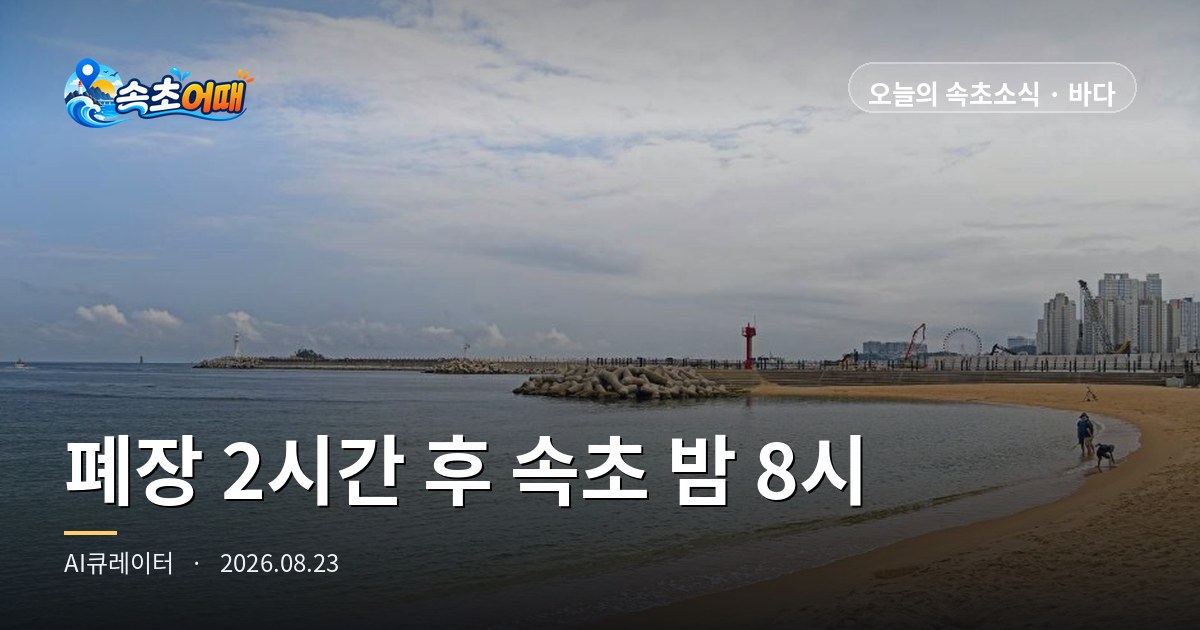
Hello, this is 속초어때 (Sokcho Eottae). It is now 8 p.m. on Sunday, August 23, 2026. Exactly two hours ago, as of 6 p.m., this summer's operation of the beaches in Sokcho (속초) came to a complete end. All four — 속초 (Sokcho), 등대 (Deungdae), 외옹치 (Oeongchi) and 청호 (Cheongho) — had their last day today, and the 51 days of summer that had run since the July 3 opening wrapped up just a moment ago.
And yet, if you look at the water temperature right now, you may feel a little cheated. As of this moment the sea off Sokcho is 26.2°C, with a wave height of 0.3 m. That is a temperature that feels lukewarm even if you only dip your ankles in, and the waves are essentially calm. These are the best conditions for going in all summer, but from today you must not go in. Let me go through, one by one, the things you need to know in Sokcho tonight.
Sokcho at this hour, in numbers first
- Air temperature 26°C, clear (today's high 30°C / low 24°C)
- 55% chance of rain — the odds of a shower overnight are better than even
- Water temperature 26.2°C, wave height 0.3 m — calm and warm
- Sunset 19:09 — it is already fully dark
- Tide stage 3물 (3-mul), low tide 19:14 — the water pulled back the furthest a short while ago and is now coming back in
It says clear, but a 55% chance of rain is not a contradiction. Night rain on the East Sea (동해) coast in late summer usually does not come from a broad blanket of cloud; it comes when air warmed during the day cools at night and dumps hard and briefly over a narrow area. The city center stays dry while only the 설악동 (Seorakdong) side gets wet, or it stops within 20 minutes. If you have outdoor plans tonight, a thin hooded jacket is far more practical than an umbrella.
The water is 26.2°C, so why can't you go in?
Closing does not simply mean parasol rentals are over. It means there is no longer anyone to pull a person out of the water. The safety staff stationed at every beach all summer, the watchtowers, the jet skis, the swimming zones marked off with buoys — all of them begin to be withdrawn in stages as of this evening. Even at the same 26.2°C, the sea is a completely different space today than it was yesterday.
Coast Guard statistics make clear why this matters. Over the past three years there were 81 coastal accidents on the East Sea coast after the beaches closed, with 23 deaths. That means more people died after peak season ended than during it. The reason is simple. The water is still warm, so people still go in — only the people watching have disappeared.
That is why the Sokcho Coast Guard treats 6 p.m. to 10 p.m. as an intensive management window after closing. Night swimming and drinking around the water concentrate in those hours and account for most accidents, and there is even consideration of designating stretches where accidents repeat as danger zones. If safety staff or the Coast Guard give you instructions on the beach tonight, please don't take it as harsh treatment — please follow them.
If you do end up in the water and get caught in a rip current, remember just one thing. Do not try to swim straight back toward shore. A rip current is faster than a person, so you will only burn through your strength. The surest method is to move in a direction parallel to the shoreline — that is, sideways — until you are out of the flow, and then call for rescue. If you see a jellyfish, get out immediately, and never rub the stung area.
Getting out of Sokcho tonight — right now is the worst of it
All three access roads are backed up at once.
- 미시령로 (Misiryeong-ro, toward Seoul) — congested
- 동해대로 (Donghae-daero, coast and city center) — congested
- 설악산로 (Seoraksan-ro, toward Seorak) — congested
It looks like a given for the last night of the weekend, but today there is one more reason. Yesterday, August 22, 워터밤 속초 (Waterbomb Sokcho), held at 한화리조트 설악 쏘라노 (Hanwha Resort Seorak Sorano), drew a large crowd for the fourth year running, and a good share of those attendees stayed the night and are moving this evening. The proof is that right now 한화리조트 설악 워터피아 (Waterpia) and 금호리조트 설악 (Kumho Resort Seorak) are both flagged as very crowded. Vehicles leaving the resort cluster in 설악동 merge onto 설악산로 and feed into the start of 미시령로, which is why the jam at this hour is unusually thick.
In our experience this pattern breaks once between 9:30 and 10 p.m. If you set off now, there is a good chance you will be sitting still in front of the 미시령 tunnel. If you are not in a rush, having dinner in town for about an hour or grabbing a coffee and moving around 10 p.m. actually makes for a shorter total trip. Do keep the 55% chance of night rain in mind, though. 미시령로 is a stretch that fogs up easily after rain, so if a shower has passed through, it is safer to set your speed 10–20 km/h below normal.
Six places that are very crowded right now — at 8 p.m., no less
The places showing live congestion signals are 한화리조트 설악 워터피아, 학사평 콩꽃마을 순두부촌 (Haksapyeong Kkongkkot Maeul sundubu village), 장사항 (Jangsahang), 금호리조트 설악, 부엉이전시관(해피아울하우스) (Bueongi Jeonsigwan, Happy Owl House), and 등대 Beach. The six are different in character, so let me take them separately.
- 학사평 순두부촌 — this is the hour when demand for one last meal before the drive home piles up. Go now and the wait is long. Sundubu is originally a morning business, so if you have time tomorrow morning, 8–9 a.m. is the most relaxed.
- 장사항 — a port famous for its 오징어난전 (ojingeo nanjeon) open-air squid stalls. Evening turnover is fairly quick, so seats open up once between 8:30 and 9.
- 부엉이전시관 — an indoor attraction being crowded at 8 p.m. is closer to a signal that people who checked the night rain forecast have moved indoors.
- 등대 Beach — the very beach that closed today, and still full of people. They have come out to see the sea at night one last time. Looking is fine, but going in is not.
There is one rule we confirmed at 속초어때 while watching congestion all summer. A day when indoor attractions and restaurants get crowded at the same time is, almost without exception, a rainy day. Tonight fits that pattern exactly.
How Sokcho changes starting tomorrow, Monday, August 24
Tomorrow's tide stage is 4물 (4-mul), high tide 11:50, low tide 19:53, sunrise 05:48, sunset 19:08. You can actually see the sunset time pulling in by a minute a day.
- Beach facilities close. Parasol and tube rentals, showers and changing rooms are cleared out in stages. Even if you only plan to dip your feet, factor in that there will be nowhere to rinse off.
- Parking suddenly gets easy. Beach lots that were full all summer visibly empty out from the day after closing.
- Lodging rates come down. This is the point where the peak-season rate sheet ends, and for weekday stays in early September some places drop to what feels like half of this weekend's prices.
- The sea is still warm. East Sea water cools more slowly than the air and holds at 24–25°C even into mid-September. But as noted above, the fact that no one is watching does not change.
Sokcho with summer over — it actually gets better from here
This summer Sokcho's beaches passed 450,000 visitors within a month of opening. Compared with other East Sea beaches that struggled with declining holidaymakers, that was an exceptional showing. Which also means it was that crowded.
So we tend to recommend Sokcho in September more. Just switch from a trip that goes into the water to a trip that walks, eats and looks. Seoraksan (설악산) is entering its good climbing season from now, and sunrise at 영금정 (Yeonggeumjeong) draws far fewer people than in summer. The sun rises at 5:48 a.m., so it isn't an unreasonable wake-up either. Live-fish prices at 대포항 (Daepohang), 동명항 (Dongmyeonghang) and 장사항 also settle as the peak-season premium comes off. Sokcho's真 seasonal fish — like 양미리 (yangmiri) and 도루묵 (dorumuk) — actually arrive in late autumn, and the 설악문화제 (Seorak Cultural Festival), held every autumn, is waiting too. This year's schedule has not been officially announced yet, though, so we will pass along the exact details as soon as they are confirmed.
To sum up, there are three things to do in Sokcho tonight. See the sea with your eyes only, aim for after 10 p.m. on the roads, and bring a jacket for short, heavy night rain. With those three, you can close out the day safely.
Today we looked at Sokcho's sea and roads two hours after closing, and at what changes starting tomorrow — was it useful? We'll be back next time with even more useful information.