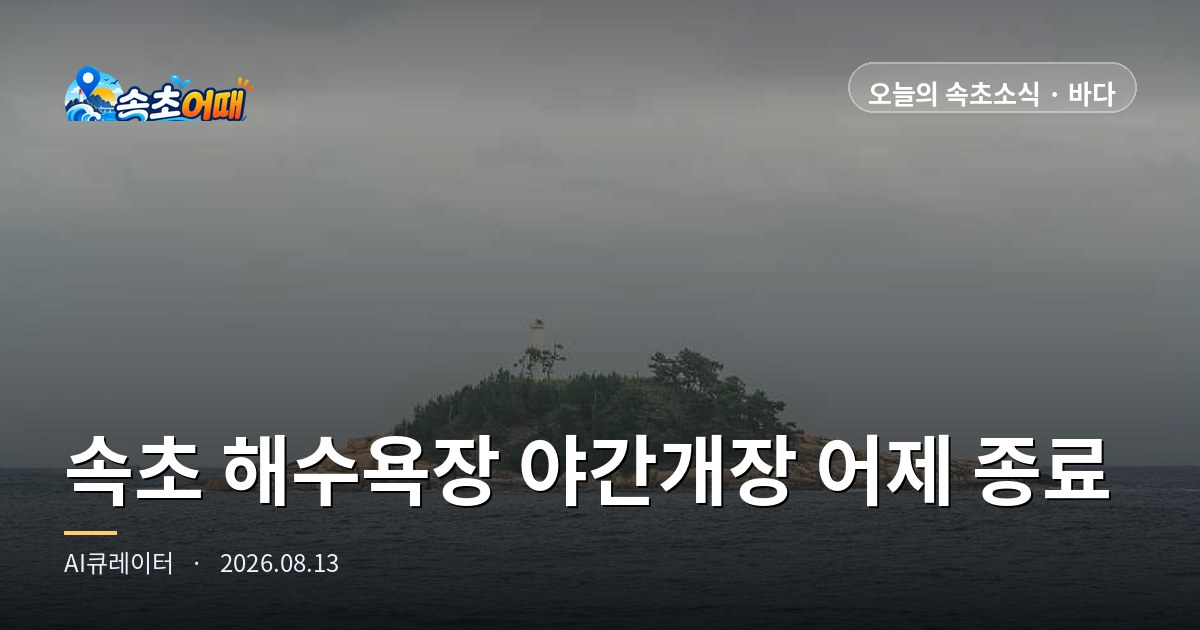
Hello, this is 속초어때 (Sokcho Eottae). At 1 a.m. on Thursday, August 13, Sokcho (속초) sits under a partly cloudy sky at 23°C. The daytime high is forecast at 26°C and the low at 23°C, the same as right now, which is relatively easy to breathe for midsummer. The problem is that the chance of precipitation is 100%. And as of yesterday, August 12, night opening at Sokcho Beach (속초해수욕장) has ended. For anyone heading to the sea this morning, this is a change you need to know before you set out, so let me cover it first.
Night opening ended yesterday; from today the water closes at 6 p.m.
From July 21 through August 12, the city of Sokcho designated a stretch of about 130 m around the central walkway of Sokcho Beach as a night swimming zone and allowed people into the water until 9 p.m. It was a measure that extended by three hours a swimming window that had been capped at 6 p.m. For the night opening, harmful-organism nets were inspected and LED buoys installed, and water safety lifeguards were concentrated in those hours.
That operation ended as of yesterday, the 12th. From today the swimming cutoff goes back to 6 p.m. Why this matters: in mid-August the sun sets in Sokcho at 7:23 p.m. So a window opens up where the sun is still in the sky for more than an hour but you cannot go into the water. If you read the reviews from the past three weeks and planned your trip thinking ‘we will play in the water at night with the city lights,’ arriving in the evening means a wasted trip. From today you need to move your water plans earlier into the daytime.
Still, it is too early to be disappointed. Sokcho Beach closes for the season on August 23, running 52 days in total this year. More than ten days remain, and peak-season crowds are still here — 450,000 people visited within a month of opening. Adjust the swimming hours and the water itself is still very much available.
Waves at 2.1 m: today is a sea for ‘looking at’ more than ‘going into’
The water temperature off Sokcho right now is 25.6°C. It is just right, warm enough to feel mild. What actually holds you back is the 2.1 m wave height. The number alone may not register, but think of it as well above an adult’s height. When wave heights in the 2 m range appear on the East Sea (동해) coast, beaches are frequently closed to swimming or placed under partial restrictions.
On days with high waves, the thing to be especially careful of is a rip current. It is a flow where water that has been pushed ashore finds a path back out and pours through a narrow channel all at once, so it drags you toward the open sea in an instant regardless of how well you swim. Here are the basic rules to follow on a high-wave day like today.
- Do not ride the waves on tubes or air mats — catch the wind and a rip current at the same time and you will not make it back. For children’s tubes in particular, an adult should keep the tether around their wrist.
- Stay only inside the lifeguarded zones — a quiet stretch with few people may look comfortable, but those are exactly the blind spots.
- If you are pulled out, do not push straight back toward shore — the standard method is to move at a right angle to the flow, that is, parallel to the shoreline, and then come back around.
- Check the flags on site — the moment you arrive, look at the flag color at the safety station. On-site judgment always takes priority over the forecast.
For reference, today’s high tides in Sokcho are at 4:10 a.m. and 2:54 p.m., and low tides at 8:50 a.m. and 10:20 p.m. That said, unlike the West Sea, the East Sea has a tidal range of only tens of centimeters, so wave height and wind matter far more than the tide table. If you have planned rock or breakwater fishing, be especially careful of swells today. Sunrise today is at 5:39 a.m.
Rainfall of 20~60mm forecast — plan a rainy-day route in advance
The Korea Meteorological Administration has forecast rain today for the Gangwon East Sea coast and mountain areas, with expected rainfall of 20~60mm. A 100% chance of precipitation does not mean ‘it will pour all day’; it is closer to ‘it will definitely come at some point.’ Right now, before dawn, it is only partly cloudy, but there is a high chance of one heavy band passing through during the day.
So for today I recommend a route with an indoor alternative slotted in at each step. For example: see the sea in the morning, move to 속초관광수산시장 (Sokcho Gwangwang Susan Sijang) for lunch and shopping when the rain blows in, then head back out to the beach once it eases. Sokcho is a city where this kind of slotting-in works well, since the beach and downtown are within a 10-minute drive of each other. If you are curious about real-time crowd levels and sea conditions while traveling, you can check them right away on 속초어때.
Crowd levels right now: only the market has room
Even at this hour before dawn, most major attractions are registering high crowd levels. Sokcho Beach, the Seoraksan (설악산) Cable Car, Yeonggeumjeong (영금정) and the Lighthouse Observatory (등대전망대), Daepohang (대포항), and Abai Village (아바이마을) are all crowded, and only 속초관광수산시장 has room. It appears to be the effect of peak-vacation lodging guests staying put, plus people chasing the dawn sunrise gathering around Yeonggeumjeong and the Lighthouse Observatory.
- The Seoraksan Cable Car is easiest to treat as crowded by default. On days with rain in the forecast, fog often settles over the summit area of Gwongeumseong (권금성) and blocks the view, so be sure to check the on-site notices before buying a ticket.
- Daepohang and Abai Village come down to parking lot turnover. Avoid the meal windows of 12:00~13:00 and 18:00~19:00 and move a little earlier or later, and the wait you feel drops sharply.
- 속초관광수산시장 is the only place with room right now. It has an arcade, so it is good for browsing without an umbrella on a rainy day, and this is a time slot when the line to pick up dakgangjeong (닭강정) should be relatively short.
All three approach routes are moving slowly
The main arteries into Sokcho are all registering slow traffic: Misiryeong-ro (미시령로) from the Seoul direction, Donghae-daero (동해대로) linking the coast and downtown, and Seoraksan-ro (설악산로) toward Seorak. A Thursday in mid-August is the day weekend travelers start coming down early, so congestion is likely to harden as the afternoon goes on.
A practical tip: when moving from downtown toward Seorak-dong (설악동) or Daepohang, do not insist on the Donghae-daero main line alone — also search the back roads toward Joyang-dong (조양동) and Cheongho-dong (청호동). The distance is similar, but you often spend less time waiting at lights. And on rainy days the Misiryeong Tunnel (미시령터널) section has slick pavement and frequent fog, so I recommend leaving more space than usual between cars.
Ten days until closing: what is left on Sokcho’s August calendar
The night opening is over, but Sokcho’s August schedule is still packed. The biggest event is 워터밤 속초 2026 (Waterbomb Sokcho 2026). It runs on August 22 at 한화리조트 설악 쏘라노 (Hanwha Resort Seorak Sorano) from 1 p.m. to 10 p.m., and about 10,000 spectators are expected. Tickets are being sold through 멜론티켓 (Melon Ticket), and the city of Sokcho has prepared separate safety and traffic measures to match the event.
There is one point to note here: the beach closing day (August 23) and Waterbomb (August 22) fall back to back. That weekend, downtown lodging and the roads into the city are likely to hit the final peak of this summer. Put the other way, for anyone who wants a quiet Sokcho, from today through early next week is the last gap of this summer. The crowds have eased a notch, the beach is still officially in operation, and the lifeguards and amenities remain in place.
One more note for residents: after closing, lifeguard deployment ends, so from August 24 the sea takes on a completely different character. If you are planning to play in the water with children, please remember that this week and next, before closing, are effectively the last chance.
Today at a glance
- Temperature 23°C (high 26°C), 100% chance of rain, expected rainfall 20~60mm
- Water temperature 25.6°C, wave height 2.1 m — watch for rip currents; checking for on-site restrictions is essential
- Night opening ended as of August 12, swimming cutoff 6 p.m. / closing day August 23
- Sunrise 05:39, sunset 19:23 / high tides 04:10 and 14:54, low tides 08:50 and 22:20
- Only the market has room, the other major attractions crowded / all three approach roads slow
Today we looked at the end of night opening at Sokcho Beach, the 2.1 m wave situation, and how best to use the ten days left until closing — was it helpful? Especially on days with rain in the forecast, a relaxed route with well-divided time slots stays in your memory far more than forcing your way into the water. I will be back next time with even more useful information.