Hello, this is Sokcho Eottae. At 1 p.m. on Friday, August 14, the roads coming into Sokcho (속초) have already shed their weekday face. That's because a three-day holiday weekend starts today. With Liberation Day on August 15 falling on a Saturday, Monday, August 17 has been confirmed as a substitute holiday, so vehicles from the greater Seoul area are heading for the East Coast all at once starting Friday afternoon. On top of that, the Korea Meteorological Administration has forecast strong swells along the East Coast through today, making this a day that calls for different judgment than usual in front of the sea. Here we've gathered only what has actually been confirmed as of 1 p.m. today.
Wave height is 1.2 m, so why the advice to "avoid approaching the shoreline"?
Right now the water temperature off Sokcho is 25.4 degrees and the wave height is 1.2 m. Looking at the numbers alone, you might think, "That seems fine?" A water temperature in the 25-degree range is among the best conditions on the East Coast this summer — you can stay in a long time without shivering. And a wave height of 1.2 m is lower than at this same hour yesterday. Yet the Korea Meteorological Administration is urging people to avoid approaching the shoreline, saying that through today along the East Coast, high waves caused by strong swells will push forcefully onto the sand or wash over rocky outcrops and breakwaters in some places.
The reason these two pieces of information look contradictory is that swells are not waves made by "the wind here and now." They are long waves already generated far out at sea that roll in over the course of several days, so even when the sky is clear and the wind is calm on site, they suddenly strike hard every so often. This is exactly the typical pattern behind the casualties that occur on the East Coast every year: someone feels reassured by the wave-height figure, stands at the end of a breakwater or on a rocky outcrop, and gets swept away by a single wave with no warning.
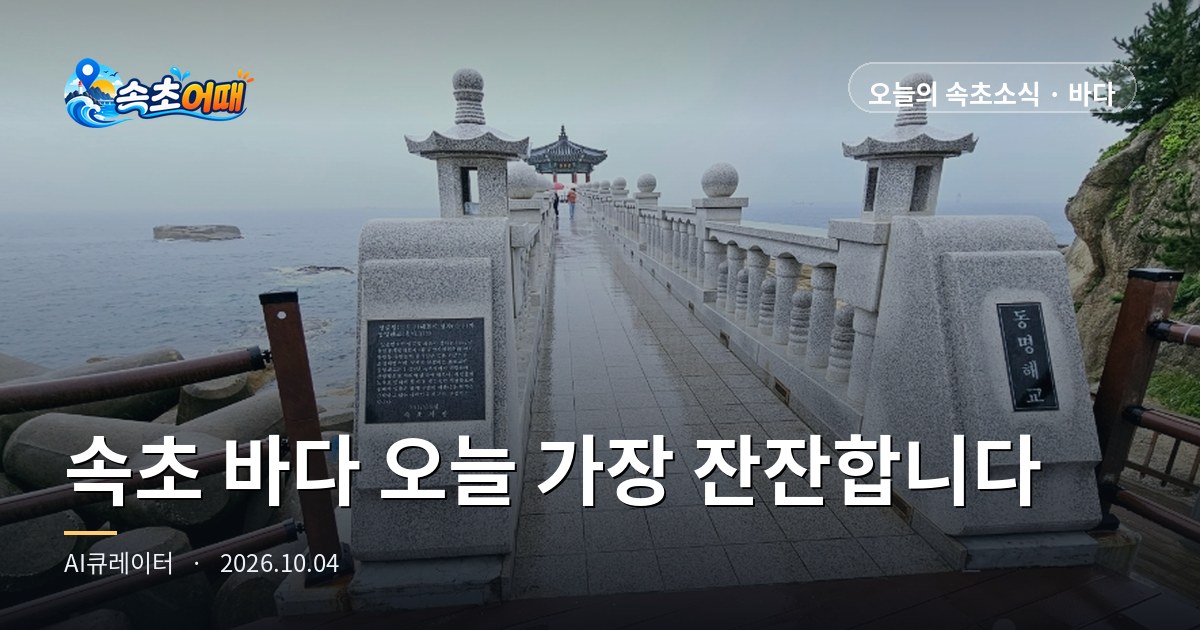
- Do not climb onto breakwaters, tetrapods, or rocky outcrops at all today. That includes the breakwaters at 동명항 (Dongmyeonghang), 대포항 (Daepohang), and 외옹치 (Oeongchi). The moment you step up just for one photo is the most dangerous.
- At swimming beaches, stay inside the buoys designated by lifeguards when you go in the water, and if an announcement comes over the loudspeakers, get out immediately regardless of the numbers.
- When you set your things down on the sand, leave plenty of distance from the waterline. Swells surge much farther inland in one go than usual.
- Between 12 p.m. and 6 p.m., there will be rain in places along the Gangwon East Coast and in the mountains. It's better to sort out your belongings and have an umbrella ready in advance.
For reference, night openings at Sokcho's swimming beaches already ended on August 12. Only daytime swimming is possible now, so for those arriving in the evening, it's realistic to change plans from water activities to a walk along the beach. The exact cutoff time for entering the water differs slightly from beach to beach, so please check the on-site notice board.
Why all three access-road corridors are tied up at once
As of 1 p.m., none of the three corridors into Sokcho are flowing freely. 미시령로 (Misiryeong-ro) in the Seoul direction is slow-moving, the coastal and downtown sections of 동해대로 (Donghae-daero) are congested, and 설악산로 (Seoraksan-ro) toward Seorak is congested as well. Understanding why this happens simultaneously makes it easier to respond.
Congestion in Sokcho on the first day of a holiday arises when "cars coming in" and "cars circulating" overlap. Vehicles that came over via Misiryeong-ro and the Seoul-Yangyang Expressway pour into downtown, while the cars already downtown keep using Donghae-daero as they move back and forth between the beaches and the ports. Add vehicles heading for Seoraksan (설악산) and the water park funneling onto Seoraksan-ro, and all three directions slow down at once. In other words, in Sokcho, "where you pass through after you arrive" matters more than "where you come in from."
- If you're arriving now: if your lodging is around 청호동 (Cheongho-dong) or 조양동 (Joyang-dong), it's faster to hook onto the inner downtown roads instead of the coastal Donghae-daero. The coastal road has great scenery, and just as many slow-moving cars.
- If you plan to arrive this evening: 4-7 p.m. is the heaviest. If possible, push it back to after 8 p.m., or leave right now and get in before 3 p.m.
- For residents: over the three holiday days, we recommend finishing grocery runs and hospital appointments in the morning. In the afternoon, the approach roads near Daepohang and Dongmyeonghang stay clogged with tourist traffic.
- Parking: this is a day when the time spent circling a port parking lot is longer than the time it takes to walk. Parking at a public lot a bit farther away and walking 10 minutes feels far faster.
Six places rated "very congested" as of 1 p.m., and the alternatives
The places currently registering as very congested in Sokcho are 부엉이전시관 (Bueong-i Jeonsigwan / Happy Owl House), the 대포항 전망대 (Daepohang Observatory), 상도문돌담마을 (Sangdomun Stone Wall Village), 등대해변 (Deungdae Beach), Dongmyeonghang, and Daepohang. What characterizes today is that indoor attractions, ports, beaches, and villages are evenly mixed in. It looks like the result of people moving indoors because of the afternoon rain forecast and people visiting the port raw-fish centers on the first day of the holiday converging at the same time.
When you check real-time congestion on Sokcho Eottae, the approach I always recommend is not to avoid the crowded places but to find an alternative of the same character one step over. If Daepohang is jammed, you don't give up on raw fish — you shift to 중앙시장 (Jungang Market) or a restaurant over toward Cheongho-dong. If Deungdae Beach is packed, you don't give up on the sea — you go to a beach where fewer people gather.
- When Daepohang and Dongmyeonghang are very congested → head toward Jungang Market or 아바이마을 (Abai Village). These are walking routes, so there's less parking stress.
- When Deungdae Beach is packed → go to the relatively roomier beaches to the north or south. That said, because of the swells today, the inside-the-buoys rule is the same at any beach.
- When Sangdomun Stone Wall Village is jammed → the village lanes are narrow, so cars tangle easily. If you go late in the afternoon as the sun drops, your photos will also come out much better.
- If indoors is the goal → combined with the afternoon rain forecast, indoor attractions are at their peak right now. It's better to push it to the slot after dinner.
Try dividing the three-day holiday up like this, day by day
If you look at the whole holiday as one lump, you'll run into the same congestion at the same places every day. It's better to plan with the differing character of each date in mind.
- Saturday, August 15 (Liberation Day): this is the day with the heaviest inflow during the holiday. A route where you see the sea early in the morning and minimize movement after lunch is the most comfortable. The Korea Meteorological Administration has forecast gusts, thunder, and lightning over the South Sea and the waters off Jeju Island on the 15th; it's best to move with the possibility of showers on the East Coast left open as well.
- Sunday, August 16: there's a forecast that gusts, thunder, and lightning will occur in places across all waters. If you've booked any at-sea plans such as fishing or a sightseeing cruise, be sure to check the forecast again the night before, and have one indoor alternative ready.
- Monday, August 17 (substitute holiday): this is the day return traffic piles up. It's best to pick one of two branches — finish a short schedule in the morning and depart before lunch, or conversely take your time enjoying the day until evening and head up at night. Departing in the in-between 2-5 p.m. window takes the longest.
The ten days in which Sokcho's summer wraps up
Once this holiday ends, Sokcho's summer enters its closing phase. This year's operating period for Sokcho's swimming beaches runs from July 3 to August 23. Counting from today, that leaves exactly ten days. Night openings have already ended, and what remains is daytime water activities. Beaches that were busy enough to draw 450,000 visitors within a month of opening this summer will wrap up their year within these ten days.
The event capping off that finale is Waterbomb Sokcho 2026. It runs from 1 p.m. to 10 p.m. on August 22 at the outdoor grounds of Hanwha Resort Seorak Sorano, and a crowd of 10,000 is expected. The city of Sokcho said it held a safety-measures meeting with the relevant agencies to review performance safety management, traffic and parking, crowd management, and the emergency medical support system. Those planning to travel toward 설악동 (Seorak-dong) that day, residents especially, would do well to factor in congestion on Seoraksan-ro during the afternoon hours in advance.
Statistics recently came out as well showing that as Sokcho tourism shifts from day trips to longer stays, visitors, lodging, and spending are all rising together. What we actually feel is similar. In the past, crowds gathered during the day and thinned out by evening; these days the ports are busy even at 8 p.m. From a traveler's standpoint, dropping the expectation that "it should be quiet by evening" works in your favor when planning, and from a resident's standpoint, it means a habit of detouring around the main roads during the evening hours has become necessary.
Just remember this much for today
- The sea is good at a water temperature of 25.4 degrees, but watch for swells. No breakwaters or rocky outcrops; stay inside the buoys.
- Chance of rain between 12 p.m. and 6 p.m. Indoor attractions are at their busiest right now.
- All three access-road corridors are delayed. Make your arrival time before 3 p.m. or after 8 p.m.
- The swimming beaches close on August 23, and night openings are over. What's left is ten days of daytime water activities.
- On the last day of the holiday, departing between 2 and 5 p.m. on August 17 is the most jammed.
The first day of a holiday never goes according to plan. Even so, if you move knowing in advance which stretches are jammed and which hours are crowded, the texture of the day changes quite a bit. Today especially, please be extra careful in front of the sea. Even when the numbers look fine, swells come without warning.
Today we've looked at Sokcho's swell advisory as of 1 p.m. on August 14, along with first-day holiday traffic, tourist-site congestion, and the schedule for the remaining ten days — was it useful? We'll be back next time with even more useful information.