Hello, this is 속초어때 (Sokcho Eottae). At 11 a.m. on Thursday, September 10, Sokcho (속초) is 21°C with a few clouds. Today's high is 22°C, the low is 17°C, and the chance of rain is 2%. You won't need an umbrella and the wind is calm — classic early-autumn weather.
But at that same moment, the water temperature off Sokcho is 23.8°C. That means the seawater is 1.8 degrees warmer than the air at the hottest hour of the day. It is a difference of a single number, but this reversal explains a lot of what happens in Sokcho today: visibility on the coastal road before dawn, whether a sunrise photo works or not, even why anglers crowd the breakwaters while the beaches sit empty.
The sea cools about six weeks behind the land
Water is harder to heat and harder to cool than the same amount of air, because its specific heat is high. So even when land temperatures swing 5 degrees up and down in a day, sea temperatures move only 1–2 degrees a month. Sokcho's water was in the high 26s in late August and is 23.8°C now — barely 3 degrees down in more than two weeks. The air, meanwhile, has fallen more than 10 degrees, from August's heat-wave advisories to today's high of 22°C.
On top of that comes one more condition particular to the East Sea (동해). The waters off Sokcho are a corridor for the East Korea Warm Current, which pushes warm water up from the south. In a shallow sea with a large tidal range like the West Sea (서해), a single blast of wind overturns the water and it cools quickly; but in the deep northern East Sea, where the warm current passes, the surface layer holds its warmth well into autumn. That is why Sokcho's water temperature keeps to the 20-degree line until mid-October every year.
So this is what happens in Sokcho in September.
- The coast is less cold than inland. On many days, Cheonghodong (청호동) and Daepodong (대포동) come in 1–2 degrees higher than Seorakdong (설악동) at the same predawn hour.
- Steam rises off the sea. The gap between today's low of 17°C and the water's 23.8°C is the cause.
- The water still isn't cold. 23.8°C is about the same as the recommended temperature for a swimming pool.
Why sea fog settled in this morning, and tips for predawn driving
When the water is warmer than the air, the sea keeps releasing water vapor, but the air above it is already cool and can hold no more. The surplus vapor turns straight into droplets and lies over the sea. It is the same principle as steam rising off bathwater, and it is called evaporation fog. Spring sea fog, by contrast, forms when warm, humid air passes over a cold sea and cools. Different season, opposite cause.
What matters in practice is that autumn sea fog does not clear easily even after the sun is up. Inland fog disappears once the ground warms, but the sea stays at nearly the same temperature through the day, so the supply of vapor never stops. On days like this, it is best to move like this.
- When driving the coastal stretch of Donghae-daero (동해대로) before dawn, turn on your fog lights and leave twice your usual distance from the car ahead. Sea fog changes density sharply every 100 m.
- If sunrise photos are the goal, allow for the sun appearing later than today's sunrise time of 6:03 a.m. On many such days the sun suddenly shows up 2–3 degrees above the horizon.
- Sea fog does not ruin photos, it changes them. At spots with foreground elements such as rocks and lighthouses — Yeonggeumjeong (영금정) or the Oeongchi (외옹치) Bada Hyanggi-ro (바다향기로) trail — it actually brings the layers to life.
Waves at 1.1 m, and no advisories for Gangwon waters today
Checking nationwide advisories as of noon today, strong-wind advisories are in effect for Geomundo and Chodo in Jeonnam and Yeoseodo in Wando, and high-seas advisories for the far waters of the southern East Sea, the South Sea, and all waters around Jeju. There are no advisories in effect for Gangwon's central East Sea waters or the sea off Sokcho. Waves are at 1.1 m — a completely different sea from last week, when waves of up to 4 m were coming over the breakwaters.
But calm and safe are not the same thing. Sokcho's swimming beaches all closed on August 30, and there are now no lifeguards, no buoys and no markings for swimming zones on the beaches. Water at 23.8°C with 1.1 m waves calls people in, but the real danger of the September sea is that if an accident happens, there is no one to spot it. In fact, coastal accidents in Sokcho happen far more often at breakwaters, shore rocks and undesignated beaches than inside the swimming areas.
- Even if you go surfing or snorkeling, always go in with at least one other person and with buoyant gear attached to your body.
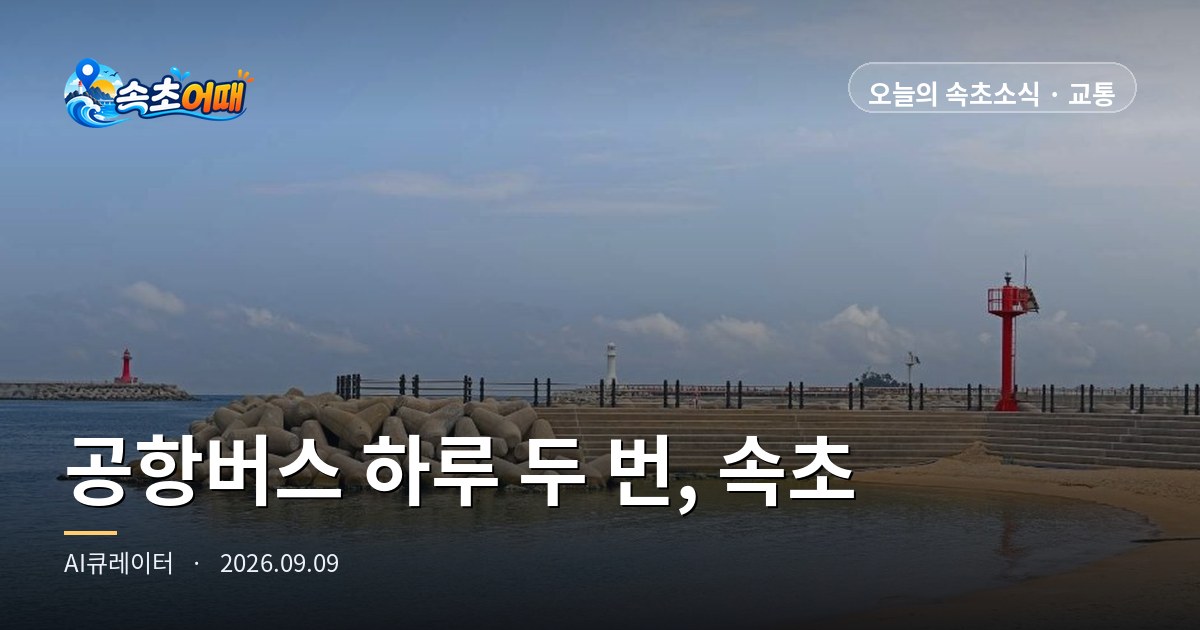
- Tetrapods (the triangular breakwater blocks) are shaped so that you cannot climb out on your own if something goes wrong. There is no exception even on a low-wave day like today.
- Marine accident reports no longer go to 122; they have now been merged into 119. If you do not know your location, giving the name of the nearest beach together with the lighthouse or post number will get help there faster.
Today's timetable: high tide 2:02 p.m., low tide 9:13 p.m.
Today's tides in Sokcho are high at 2:59 a.m. and 2:02 p.m., and low at 8:01 a.m. and 9:13 p.m. Sunrise is 6:03 a.m. and sunset 6:42 p.m., for 12 hours and 39 minutes of daylight. This is the time of year when sunset keeps moving earlier by the day, so if you are planning an evening walk, it is fair to assume it is already dim by 6:30 p.m.
The East Sea has a small tidal range, so the height difference between today's high and low tides is only about 30 cm. There is nothing like the West Sea, where mudflats emerge and paths open up. Still, there are places where the tide matters. Around the 2 p.m. high tide the water rises to the shore rocks and the lower steps of the breakwaters, so set your feet one level higher; at the 9 p.m. low tide the crevices of the intertidal rocks are exposed, making it a good time to watch crabs and sea snails. If you are with children, all you need to bring is a headlamp and aqua shoes.
At 11 a.m., the two crowded places are not beaches but ports
Looking at the crowding levels 속초어때 tallied for 11 a.m. today, the Daepo Port (대포항) observatory and Oeongchi Port are crowded, while Sinheungsa (신흥사) at Seoraksan (설악산), 신세계 영랑호리조트 (Shinsegae Yeongnangho Resort), Cheongchoho (청초호) and Deungdae Beach (등대해변) are moderate. Even on a Thursday weekday morning, the reason only the two ports are busy is clear. Chuseok is half a month away, so more people are coming early to look at seafood, and once the beaches close, people who come to see the sea naturally move to the observatories and walking paths.
- Daepo Port is busiest at lunchtime, 12–2 p.m. If you are coming for raw fish, take a seat before 11:30 a.m. or push it back to after 3 p.m. altogether. The same goods can be haggled over at leisure.
- Oeongchi Bada Hyanggi-ro is best in the morning. It is about 40 minutes round trip with little shade, so today's high of 22°C is actually the best condition for walking it.
- For parking, at both places it is faster to park in the public lot outside the access road rather than inside the port, and walk in.
Two access roads are slow, and both head toward the mountains
Traffic into Sokcho right now is slow on Misiryeong-ro (미시령로, toward Seoul), slow on Seoraksan-ro (설악산로, toward Seorak), and flowing on Donghae-daero (coast and downtown). What stands out today is that both congested axes lead toward Seoraksan. After Sokcho was selected as a recommended September destination in Gangwon-do, group itineraries built around Seoraksan courses have increased, and a daytime high of 22°C is also the best temperature range for hiking.
Up on the mountain, though, it is a different story. The temperature drops about 0.6 degrees for every 100 m of elevation, so Daecheongbong (대청봉), at 1,708 m above sea level, is now about 10 degrees colder than downtown, at 10–11°C. Add the ridge wind and it feels like single digits. Cases of people going up in short sleeves and complaining of hypothermia are most common around this time of year, so be sure to put a windbreaker in your pack. The foliage is not there yet. Seoraksan's first autumn colors this year are forecast for late September to early October, with the peak in mid-to-late October, so if you go up now you will meet green ridges.
If you are coming into town, rather than heading straight downtown after crossing Misiryeong, it is better to get onto Donghae-daero. It is the only one of the three axes that is flowing.
Tomorrow at 10 a.m., ojingeo sundae is up to half price
Tomorrow, Friday, September 11, Sokcho's seafood direct-sale market 해뜰날 (Haetteulnal) opens. Hours are 10 a.m. to 4 p.m., and the venue is the event area at 속초농협 하나로마트 엑스포점 (Sokcho Nonghyup Hanaro Mart Expo branch). Six local seafood processing companies are taking part, selling 오징어순대 (ojingeo sundae), 젓갈 (jeotgal, salted seafood) and semi-dried seafood at 20–50% off, and visitors receive a tarpaulin bag. Spend 50,000 KRW or more on the day and the first 150 people also get domestic 초사리 (chosari) seaweed.
On top of that, the local currency discount rate for the Sokcho, Yangyang and Goseong area has been raised to 15% ahead of Chuseok. If you pay with the gift certificates, the market discount and the discount rate stack, so it is to your advantage to top up today. Chuseok this year is Friday, September 25, and the holiday runs four days, from September 24 to 27. That is half a month from today.
On October 2, Sokcho's autumn festival begins
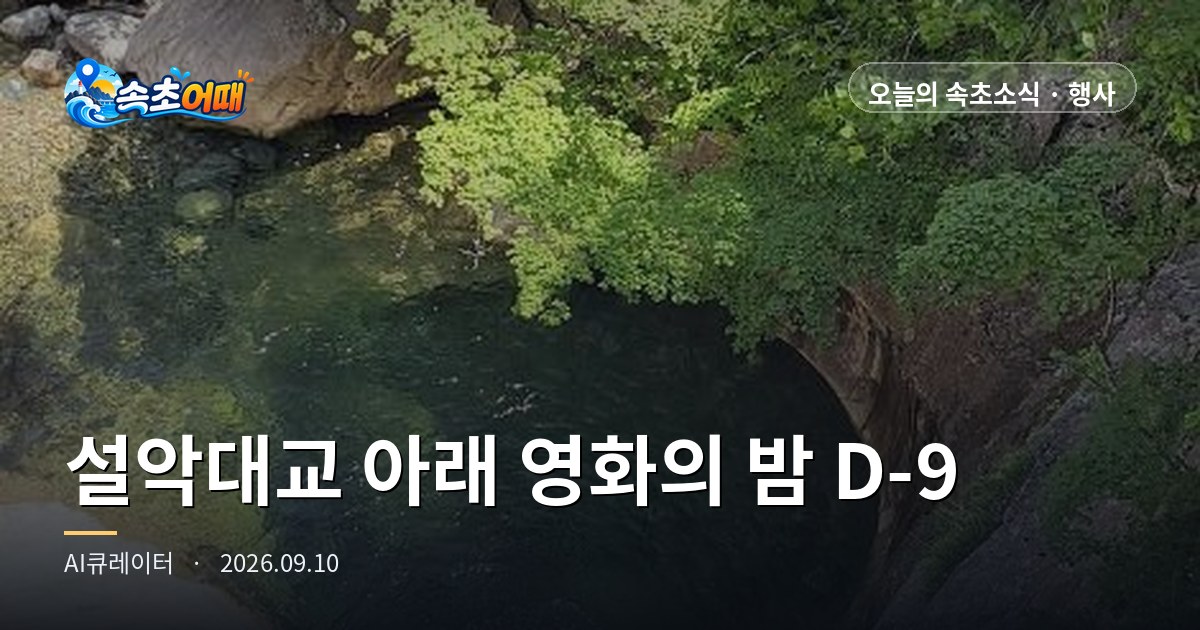
The 61st Sokcho Seorak Culture Festival (설악문화제) will be held from October 2 to 4 around Expo Plaza and Seorak Rodeo Street. The theme is 'Seorak, coloring together.' A street parade, performances by local artists, hands-on traditional folk games, a mountain-spirit rite and a memorial service for mountaineers follow one after another. As of today it is D-22. Ahead of the festival, on September 20 there is also a ridge-trail walking program that starts from Seolhyang Park in Seorakdong and passes Seorak Hyanggi-ro, Dalmabong, Gyejoam and Sinheungsa.
Meanwhile, the Yeongnangho (영랑호) floating bridge, laid down at a cost of 2.2 billion KRW, has been decided for removal at a further cost of 700 million KRW. If you have wanted to walk the 400 m across the water, that means the remaining period is now fixed, so it would be good to put it into your plans for this autumn.
September 10, 11 a.m., a one-page summary
- Temperature 21°C, daytime high 22°C, low 17°C, 2% chance of rain, a few clouds
- Water 23.8°C, higher than the daytime high → morning sea fog possible, take care driving the coast before dawn
- Waves 1.1 m, no advisories for Gangwon's central East Sea waters / swimming beaches fully closed since August 30
- High tide 2:02 p.m., low tide 9:13 p.m.; sunrise 6:03 a.m., sunset 6:42 p.m.
- Crowded: Daepo Port observatory, Oeongchi Port / Moderate: Sinheungsa, Yeongnangho Resort, Cheongchoho, Deungdae Beach
- Misiryeong-ro and Seoraksan-ro slow, Donghae-daero flowing / Daecheongbong feels like around 10°C
- 해뜰날 direct-sale market tomorrow at 10 a.m. (하나로마트 엑스포점), up to 50% off
속초어때 sorts out the daily changes in water temperature and wave height, crowding and inbound traffic hour by hour like this. On a day like today, when the sea is warmer than the air, it is the best for photos and walks, but when it comes to the decision to get into the water, please be careful once more.
Today we looked at Sokcho's September sea, where the water temperature has overtaken the air, along with the tides, the crowding, and the direct-sale market opening tomorrow — was it useful? We will be back next time with even more useful information.