Hello, this is 속초어때 (Sokcho Eottae). Sokcho (속초) is in a slightly odd state at 4 p.m. on Sunday, September 6. The sky is partly cloudy and the temperature is 25 degrees, yet the forecast puts the chance of rain at 98%. The beaches all closed at the end of August and stand empty, but three roads in and out of Sokcho are congested at the same time. And of the six spots flagged as 'very crowded' today, the most striking one is neither a beach nor a harbor — it is Haksapyeong (학사평) Kkongkkot Maeul (콩꽃마을) sundubu village, the first village below Misiryeong. Here is a breakdown, with actual figures, of why sundubu restaurants of all places are jammed at 4 p.m. on a Sunday, and what closes within the next two hours.
Half of the six 'very crowded' spots right now are places to eat and walk
As of 4 p.m., the places with the strongest crowding signals are as follows.
- Haksapyeong Kkongkkot Maeul sundubu village — very crowded
- 부엉이전시관 (Happy Owl House) — very crowded
- Cheongchoho (청초호) — very crowded
- Sokcho Beach — very crowded
- Dongmyeong Port (동명항) — very crowded
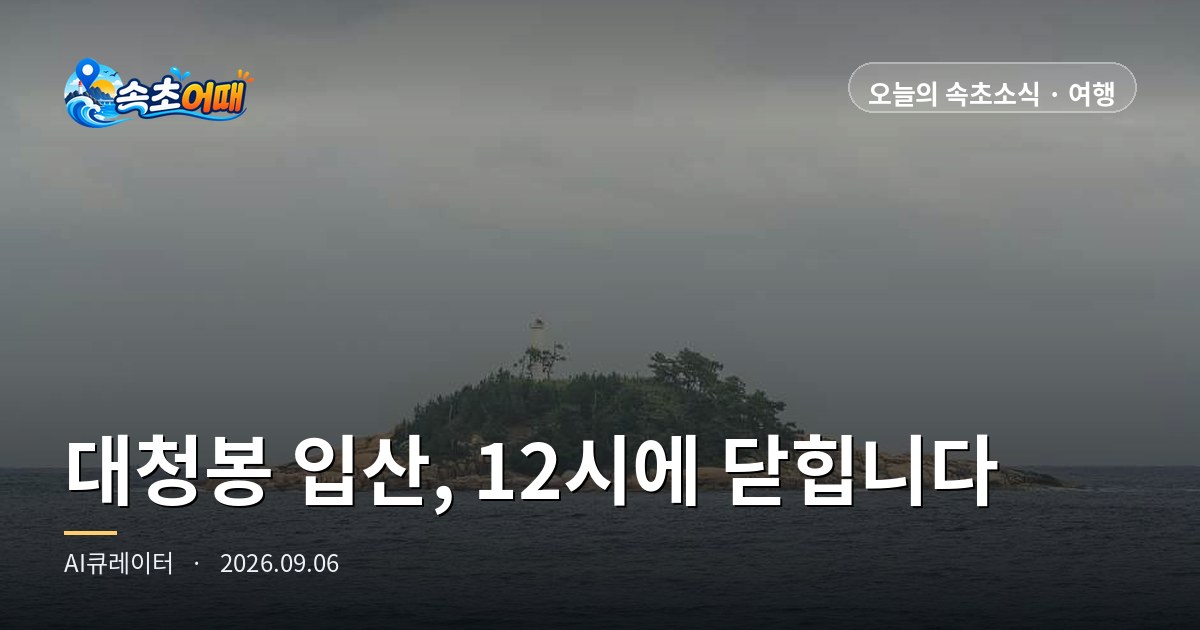
- Daecheongbong Peak, Seoraksan (설악산) — very crowded
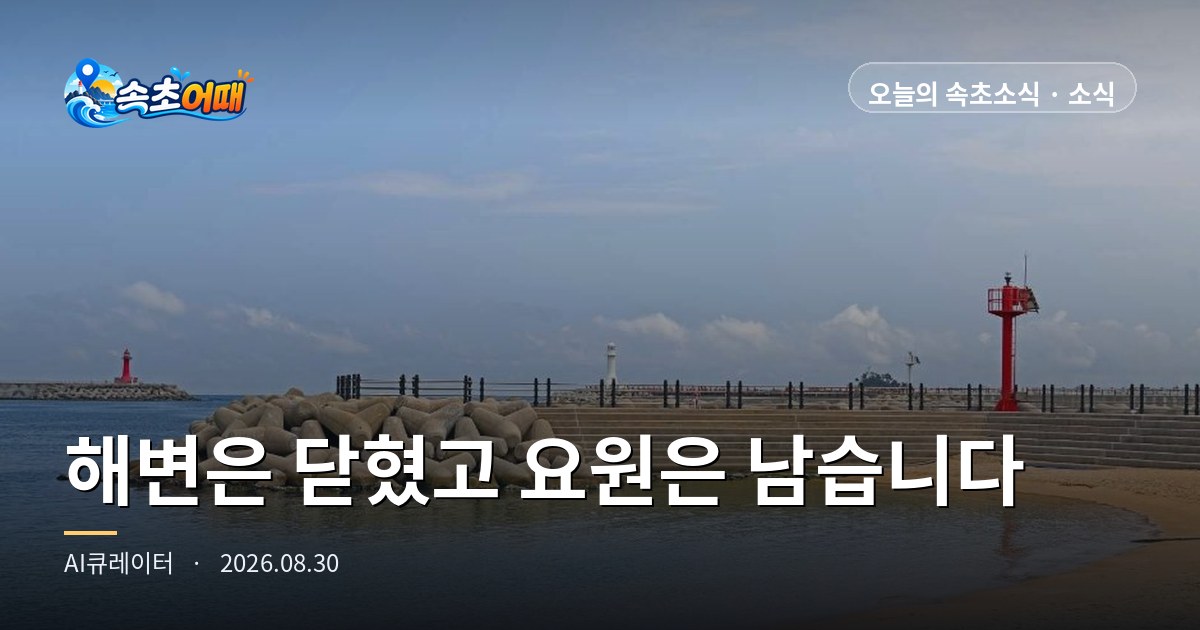
Access traffic is also flagged as congested on all three routes: Misiryeong-ro (toward Seoul), Donghae-daero (coast and downtown), and Seoraksan-ro (toward Seoraksan). One point deserves emphasis here. Sokcho Beach being 'very crowded' does not mean crowds are in the water. Sokcho's beaches ended their operating season at the end of August, and Deungdae Beach, the last one still open, closed on August 30. The people on the beach now are not going in — they are walking. In other words, today's congestion is not about swimming; it is the result of three things overlapping in the same time slot: meals, strolls, and the drive home.
Why Haksapyeong sundubu village clogs up at 4 p.m. on a Sunday of all times
Open a map and the reason for Haksapyeong is immediately visible. It is the first village on the route over Misiryeong toward Seoul, and the point where cars coming down from Seoraksan into town merge with cars heading out of town. Some 80 or so sundubu restaurants line the roadside, and all of their parking lots are entered and exited directly from the main road. When a few cars wait to turn left, the line backs up behind them.
Then the timing compounds it. Between 3 and 5 p.m. on a Sunday is both a 'late lunch, early dinner' window and a 'last meal before heading back up' window. On a day like today, when even Seoraksan-ro is congested, everyone coming down from Daecheongbong and Sogongwon merges straight into this stretch. A crowded sundubu village is, in effect, a signal that the drive-home procession has begun.
The roots of Haksapyeong sundubu lie on this same road. In 1965, a grandmother named Kim Yeong-ae from Yangyang began making and selling tofu, and in the 1970s, when construction on nearby condominiums started, the tofu supplied to workers' canteens spread by word of mouth until the entire village became a sundubu village. Using seawater as the coagulant is cited as the feature that gives the sundubu here its soft flavor. That this is not tourist food but a 60-year-old everyday food is why it still draws people.
Here are some practical tips that are useful at this hour.
- Large roadside restaurants have long waits for parking. Go just one block in toward the alleys behind the reservoir and tables turn over faster.
- Rather than forcing a left turn off the main road, it is ultimately faster to go one stretch further, turn around, and enter with a right turn.
- If you are heading home, do not change the order. All three roads are blocked right now, so spending an hour on a meal and then setting off beats losing an hour on the road.
- If you do not want to wait, takeout is an option. But sundubu goes watery as it cools, so it is only worth it if you can eat it within 30 minutes.
98% chance of rain — not falling now, but it will fall today
According to the Korea Meteorological Administration forecast, the Gangwon east coast and mountain areas will be generally cloudy today with rain in places, with expected rainfall of about 5–10 mm. There is no confirmed information that a heavy-rain weather advisory is currently in effect for Sokcho. In short, it is rain that one umbrella can handle, but the figure of 98% is best read as 'it will definitely pass through at some point today.'
The temperature is a high of 25 degrees and a low of 22 degrees. At 22 degrees it will not be cold even at night, but as is typical on the east coast, if a sea breeze comes in as the rain passes, the wind chill in wet clothes drops sharply. If you still have outdoor plans, move them up to before sunset, and it is worth keeping a light windbreaker in the car.
Indoor options for a rainy afternoon, and their closing times
Starting with the places that have the least time left as of right now.
- 부엉이전시관 (Happy Owl House) — open from 10:00 to 18:00, with last admission at 17:30. Leaving now still leaves some margin, but this is the time slot when the Haksapyeong direction gets blocked, so allow plenty of travel time. You can see some 5,000 owl items collected from around the world along with handmade fabric art, and admission is 7,000 KRW for adults, 6,000 KRW for elementary, middle, and high school students, and 5,000 KRW for young children. The address is 118 Baramkkotmaeul-gil, Sokcho. It is closed every Monday, so putting it off until tomorrow means missing it.
- 속초관광수산시장 (Sokcho Tourist & Fishery Market) 'car-free street' — vehicle traffic is restricted on two stretches, Jungang-ro 147beon-gil and Jungangsijang-ro, daily from 10:00 to 18:00. It was recently reported that vehicle traffic on these stretches has dropped sharply since the measure took effect and that it has settled in without accidents. If you have children or a stroller, it is far easier to go before the restriction lifts at 18:00. After six, the cars come back in.
- 속초문화예술회관 (Sokcho Culture and Arts Center) — the September calendar is packed. In the exhibition hall, the 5th S-RGB Members' Exhibition runs from the 4th to the 11th, followed by the Yeongrangho Chilseok Culture Festival Exhibition on the 12th–16th, the 'Waves, Light, and Reflection in Harmony' photo exhibition on the 17th–22nd, and the Hojeong Jo Jeong-seung Retrospective from the 29th. Performances scheduled include the Arco Violin Ensemble regular concert on the 12th, 'Our Gagok, Connecting Hearts' on the 15th, the Gaetmadang gugak performance on the 17th, and the madanggeuk play 'Jjokbit Hwanghon' on the 19th. Viewing hours may differ on Sundays, so it is worth checking the center's schedule before visiting.
When you check real-time crowd levels on 속초어때, keep this in mind as well. An indoor facility marked 'very crowded' means the queue is long, so the closer it gets to closing time, the more the last-admission time matters more than the crowd level.
The sea today is for looking at, and no more
The water temperature is currently 24.4 degrees and the wave height is 1.1 m. The numbers alone make it look swimmable, but every beach in Sokcho has already ended its season and no lifeguards are stationed. There was also a recent accident in which a person in their 30s died while snorkeling at an undesignated beach in Sokcho. Accidents always happen outside the controlled beach areas, not inside them. Outside the designated zones there are stretches where the depth suddenly drops and there are rip currents, and no one can judge these by eye.
Today's tidal cycle is 2-mul (2물), with high tide at 9:10 a.m. and low tide at 5:59 p.m. The water will keep going out for about two hours from now. It may look like a good time to go down onto the rocks or the intertidal zone, but wet rock on a day with rain in the forecast is the condition most likely to cause a slip. With waves at 1.1 m, never climb onto the tetrapods on the breakwater.
Instead, the sea is good for photos today. Sunset is at 18:48, and the end of civil twilight, when light still lingers in the sky, is at 19:15. If the current partly cloudy conditions hold, 18:20 to 19:00 is the best window. The Cheongchoho walking path and the sands of Sokcho Beach have lights on at this hour, making them easy to walk.
Other Sokcho news worth knowing today
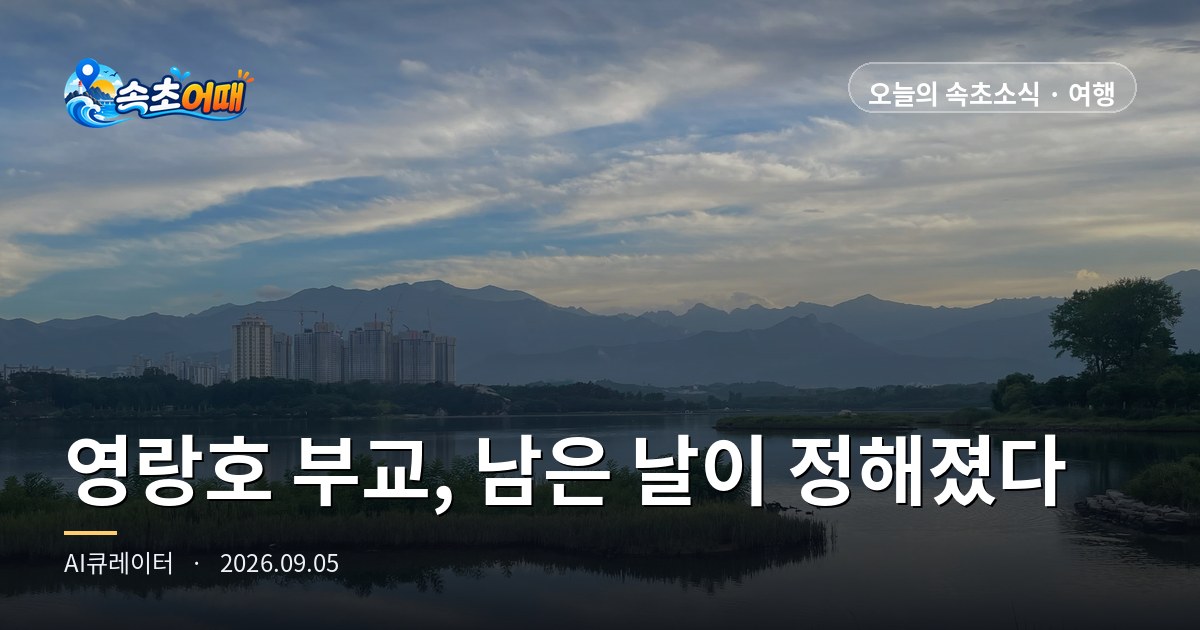
- Yeongrangho (영랑호) floating bridge — on August 31, the Sokcho City Council passed a supplementary budget bill including 700 million KRW in demolition costs, so follow-up procedures are beginning. However, steps such as detailed design remain, so you can still walk it for now. If you have wanted to walk the 400 m across the lake, this autumn is the chance.
- Launch of Simin Gwolli Sokcho (시민권리속초) — a new civic group has launched with a platform of monitoring city administration and offering policy alternatives. That is one more voice on local issues, including the floating bridge.
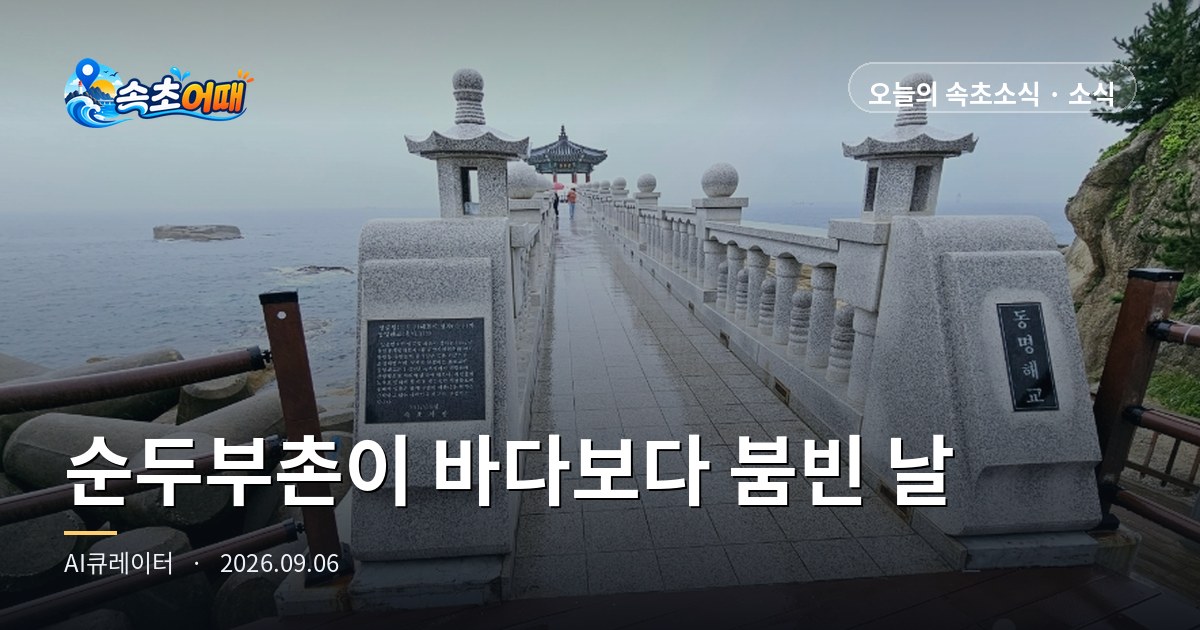
- Why Dongmyeong Port is crowded — the grilled-fish alley in Dongmyeong-dong was recently featured on television, increasing weekend visitors. Dongmyeong Port is very crowded again today. For parking, it is faster to park toward Yeonggeumjeong and walk in than to park inside the harbor.
The rest of today's timetable, as of 4 p.m.
- 17:30 — last admission at 부엉이전시관
- 17:59 — low tide (2-mul); the water comes back in after this
- 18:00 — car-free street restriction lifted at 속초관광수산시장; 부엉이전시관 closes
- 18:48 — sunset
- 19:15 — end of civil twilight, effectively when it gets dark
To sum up, there are three key points about Sokcho today. First, the congestion is caused by meals and the drive home, not the sea, so avoid the Haksapyeong–Misiryeong-ro stretch, or else eat dinner right there and set off late. Second, the chance of rain is 98% but the amount is only around 5–10 mm, so one umbrella is enough. Third, most indoor facilities close at 18:00, so you have to move now to get in today.
Today we looked at Sokcho's real-time congestion, weather, and tides as of 4 p.m. on Sunday, September 6, along with why Haksapyeong sundubu village gets jammed at this hour — was it useful? We will be back next time with even more useful information.