Hello, this is 속초어때 (Sokcho Eottae). At 10 p.m. on Sunday, August 30, Sokcho (속초) is sitting at 24°C under cloudy skies with a 67% chance of rain. As of 6 p.m. this evening, not a single swimming beach in Sokcho remains where you can officially enter the water. But the news that really matters in Sokcho tonight is not that they 'closed.' It is that even after closing, people stay in the sea, and the management does not end completely. Today I will center on that story and lay out the actual situation in Sokcho at this hour.
Sokcho by the numbers, right now (10 p.m.)
- Temperature 24°C, cloudy / today's high 26°C, low 23°C
- Chance of rain 67% — a figure that means rain could begin overnight
- Water temperature 25.4°C / wave height 0.8 m
- Tide 10-mul, with the second low tide at 10:47 p.m., passing just now
- Sunset was already at 6:59 p.m.
Look only at the numbers and you might think, 'the sea isn't in bad shape at all?' A wave height of 0.8 m counts as calm, and a water temperature of 25.4°C is still midsummer water. That very combination is what calls for the most caution in Sokcho starting tonight. The conditions that draw people into the water are unchanged, while only the system that protected them is being withdrawn.
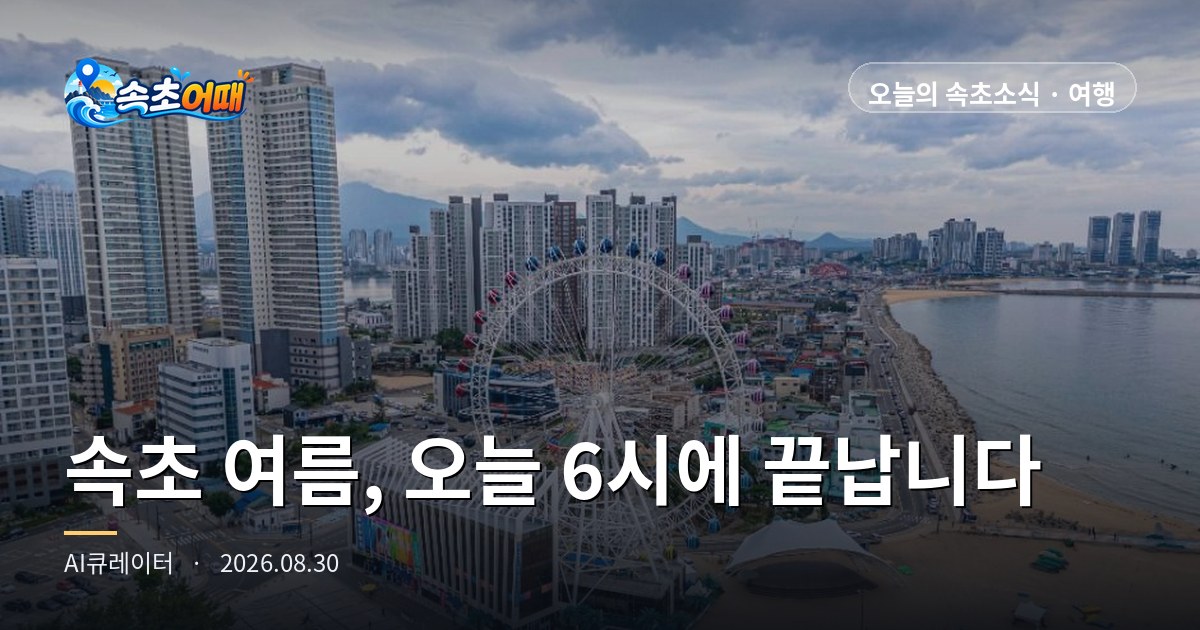
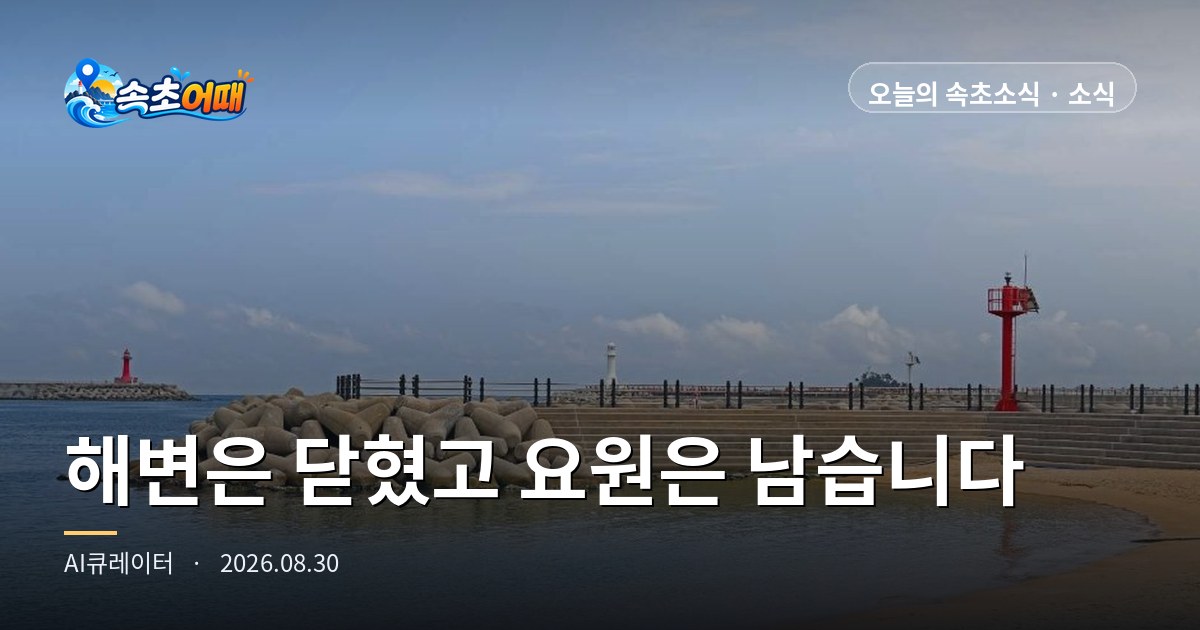
At 6 p.m. this evening, Sokcho's last swimming beach closed
This summer the City of Sokcho closed three beaches first — Sokcho, Oeongchi and Cheongho — on August 23, and extended operations by one week, through August 30, at Deungdae Beach (등대해수욕장) alone. The reason for the extension was clear. Deungdae Beach is shallow and its waves are usually calm, so it draws many family visitors, and demand for water play was expected to continue through the end of August.
That one week ended this evening at 6 p.m. with the cutoff for entering the water. From this moment on, the number of swimming beaches open in Sokcho is zero. Go to Deungdae Beach tomorrow morning and the sand and the sea will be exactly as they were, but the system called a 'swimming beach' — the watchtowers, the announcements, the buoys marking the zones — is not what it was yesterday.
That said, the lifeguards are not all pulling out as of today
This is the part many people have wrong. The City of Sokcho, expecting that residents and tourists will still visit the shore to escape the late heat even after the official closing, has announced that it will keep water safety lifeguards stationed at the closed beaches for a certain period. On-site patrols and safety guidance activities will continue as well. The backdrop is the string of drowning accidents along the East Coast (동해안) recently.
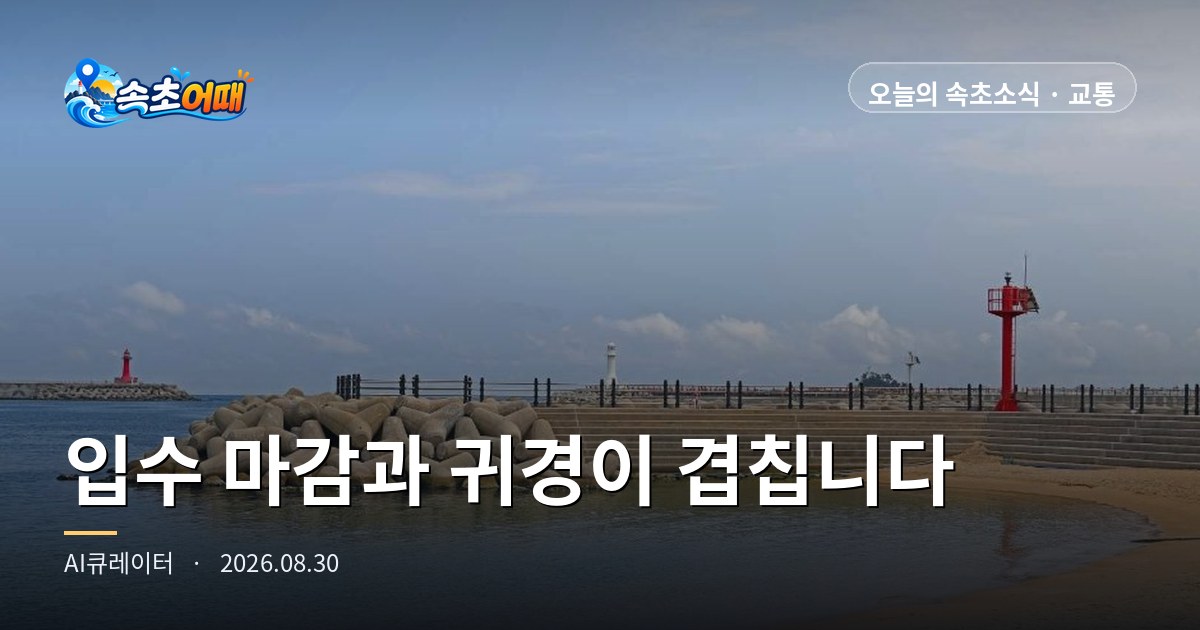
The Sokcho Coast Guard Station is also repeating the message that 'you must not go into the water at closed beaches,' and is even reviewing a plan to designate the areas around closed beaches as danger zones. In fact, this month a person in their thirties died while snorkeling in the waters off Sokcho, and there were also an accident involving a tube at a closed beach and a missing-person report during snorkeling.
So here is the sentence to keep in mind tonight. 'Lifeguards are still there' does not mean 'you may go in.' The deployment is temporary, and the zones covered are limited. Above all, anything outside the watch area — undesignated beaches, breakwaters, rocky shores, the areas around the port — was never subject to swimming-beach safety management in the first place. And those outer areas are exactly where accidents keep happening.
Why the number 25.4°C is more dangerous from here on
Even as September approaches, the East Sea's water temperature does not plunge within a few days. At 25.4°C right now, dipping your feet in during the day feels 'refreshing,' not 'cold.' The problem is that people's judgment moves according to that temperature.
- A wave height of 0.8 m is not a safety guarantee. Rip currents form even on days when the waves are low. If anything, it is when the sea looks calm that people go out far.
- The sea at night is a completely different level of difficulty for rescue. Sunset was at 6:59 p.m., so it is already pitch dark. A person who has fallen into the water cannot make much noise. A situation that would have been visible in daylight is invisible at night.
- There is the current around low tide. Today's low tide is at 10:47 p.m. The rocks exposed as the water drains, and the channels between them, are not the terrain you walked in daylight.
- There is a rain forecast attached. A 67% chance of rain. Wet breakwaters and rocky shores are where slip accidents happen most often.
If you are going near the water anyway, please keep at least these three. Wear a life jacket, never enter the water after drinking, and do not go in alone. Snorkeling can feel safe because you have equipment, but a considerable share of accidents along the East Coast after the closings have occurred while snorkeling or diving.
Six places marked 'very crowded' right now — what is going on at 10 p.m.?
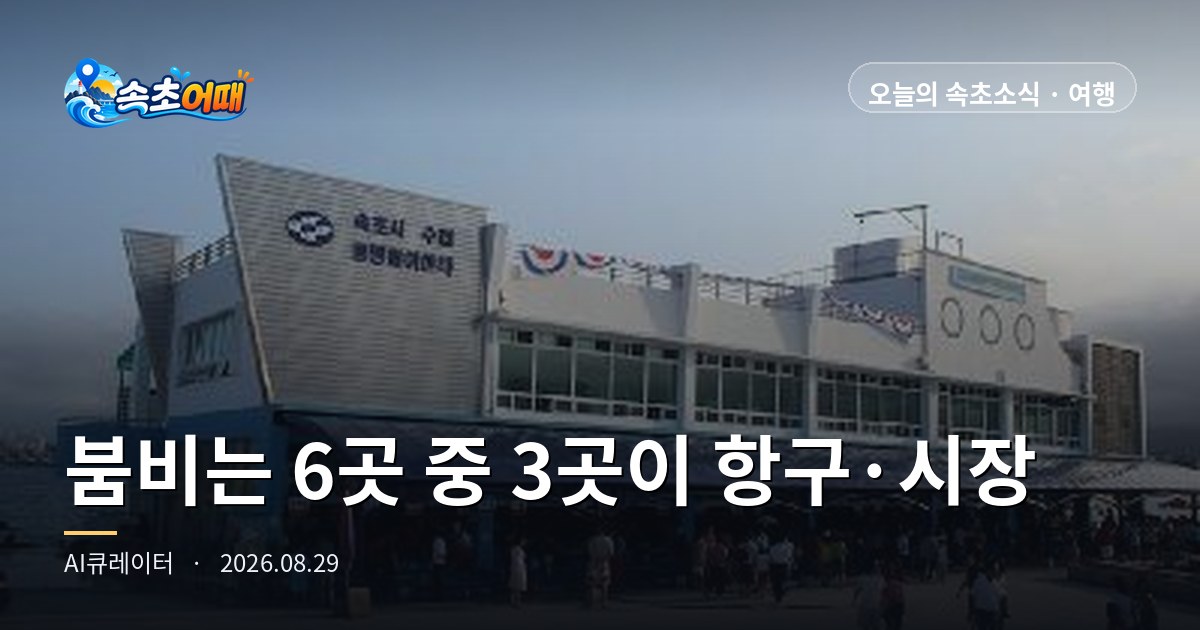
In the crowding figures compiled by 속초어때 at this hour, six places register as very crowded. Sokcho Beach, Cheoksan Foot Bath Park (척산족욕공원), Seorak Haemaji Park (설악해맞이공원) in Sokcho, 한화리조트 설악 워터피아 (Hanwha Resort Seorak Waterpia), 부엉이전시관(해피아울하우스) (Bueongi Owl Exhibition Hall / Happy Owl House), and Sokcho Port.
There is one thing not to misread here. This indicator is an estimate based on the number of people staying in the given area, so it does not mean 'that facility is open for business right now.' Broken down as of 10 p.m., it looks like this.
- Indoor and paid facilities that have already closed: Cheoksan Foot Bath Park, Waterpia, the Owl Exhibition Hall. These are stretches where visits accumulated during the day get counted together with the crowds at nearby lodgings and parking areas. Waterpia in particular has moved its closing time earlier for the seasonal changeover, so a nighttime visit is pointless.
- Outdoor spaces open 24 hours: Seorak Haemaji Park in Sokcho, and the sand at Sokcho Beach. What is crowded now is mostly people strolling and taking in the night view. Walking is fine, but as of today the beach is not a zone for entering the water.
- Places that actually come alive at night: Sokcho Port. Fishing boats coming and going overlap with the flow of people around the port's restaurants and raw fish centers. Note, though, that even with lighting there are stretches inside the breakwater with no railings, so if you are with children please use the inner walkway.
If I had to pick just one option at this hour that is 'free, open late, and good for walking,' it would be Seorak Hyanggiro (설악향기로) in Seorakdong. Its roughly 2.7 km walking path links a 765 m skywalk and a 98 m suspension bridge, with no admission or parking fee. In summer it is open from 6 a.m. to 10 p.m., so today's closing time has already passed, but if you are planning a September trip starting tomorrow, it is worth putting at the top of the list.
If you are leaving Sokcho right now
The situation on the access roads is congestion on Misiryeong-ro (미시령로, toward Seoul), congestion on Seoraksan-ro (설악산로, toward Seorak), and slow going on Donghae-daero (동해대로, the coastal and downtown route). Ten p.m. on a Sunday is when returning traffic surges once more, and a rain forecast is layered on top.
There are effectively two choices. Set off now and accept the congestion, or push it back a beat to closer to midnight. If you delay, though, the rain may pick up in earnest overnight, which could reduce visibility on the Misiryeong Tunnel stretch. Personally I would recommend getting through the mountain road before the rain arrives. If you are going to spend the time downtown, the routes toward the city center are less clogged than the coastal road.
From tomorrow, Sokcho becomes a 'recommended destination of the month' for September
Summer ending does not mean Sokcho's season is over. Gangwon State (강원특별자치도) and the Gangwon Tourism Foundation have selected Chuncheon and Sokcho as the recommended destinations of the month for September under 2026 Visit Gangwon Year. Autumn hiking in Seoraksan National Park (설악산국립공원), a walk along Seorak Hyanggiro, Cheoksan Hot Springs, and a finish at 속초관광수산시장 (Sokcho Tourist and Fishery Market) were introduced together as a course.
Here are some dates worth marking for September as well.
- The madanggeuk play '쪽빛황혼' (Jjokbit Hwanghon) — September 19 at 2 p.m., Grand Theater of the Sokcho Culture and Arts Center. Tickets are 20,000 KRW, with a 50% discount for residents of the Seorak area. Up to 4 tickets per person can be booked.
- Autumn foliage on Seoraksan (설악산) — the average date for the first foliage on Seoraksan is September 28, and for peak foliage October 17. From late September the congestion pattern on Seoraksan-ro will be completely different from today's.
- Timed car-free street at 속초관광수산시장 — it is drawing praise as vehicle traffic has actually decreased. It is also a favorable stretch for walking on rainy days.
- Indoor alternatives — the Sokcho Municipal Museum drew 26,000 visitors this summer, up 32% from last year. It is an especially useful card in early September, when rain is often in the forecast.
A preview of tomorrow (Monday, August 31)
- Sunrise 5:54 a.m. / sunset 6:57 p.m. — daylight is 4 minutes shorter than yesterday
- Tide 11-mul, high tides at 4:40 a.m. and 4:49 p.m. / low tides at 10:52 a.m. and 11:16 p.m.
- Weather the Korea Meteorological Administration forecasts a generally cloudy pattern with rain nationwide, and Gangwon-do, including the Yeongdong region of Gangwon, is expected to see 30–80 mm of rainfall from August 31 to September 1
For a Monday with rain in the forecast, indoor spots and the market are the answer rather than the sea. Since it is the last day of August, wrapping up summer with a plate of raw fish or some dakgangjeong would not be a bad idea either.
Today we looked at how the closing of Deungdae Beach brought Sokcho's count of open beaches to zero, the fact that water safety lifeguards are nonetheless staying on temporarily, what the six 'very crowded' spots at 10 p.m. actually mean, and Sokcho's September schedule — was it useful? Summer ended at 6 p.m. this evening, but the sea is still warm at 25.4°C. Do not be fooled by that temperature, and from tomorrow please enjoy Sokcho beside the water rather than in it. I will be back next time with even more useful information.