Hello, this is 속초어때 (Sokcho Eottae). At 2 p.m. on Monday, September 7, Sokcho (속초) is 24°C under partly cloudy skies. Today's forecast high is 24°C, so we are already past the warmest stretch of the day, and with a 78% chance of rain, even if nothing has started falling yet, this is a day to keep an umbrella in hand when you go out.
But today is also a day you cannot simply pass over on the calendar. Tonight at 11:41 p.m., Baengno (백로, 白露), the fifteenth of the 24 solar terms, begins. It is the term that means white dew starts to form on blades of grass, and meteorologically it is the signal that nights when the ground temperature falls below the dew point are beginning in earnest. In a city like Sokcho, where the sea and the mountains sit right up against each other, this solar term arrives with real accuracy to the senses. Go through today's numbers for Sokcho one by one and you can see why summer officially ends tonight.
A 5-Degree Daily Swing — And This Is the Last Week for That Number
Today's high in Sokcho is 24°C and the low is 19°C. The difference is only 5 degrees. As it has all summer, the sea is holding on to heat, so day and night temperatures still do not spread far apart. But once Baengno passes, that gap widens fast. As the sun sits lower, the daytime hours for warming grow shorter while the nighttime hours for cooling grow longer.
So the most practical tip for anyone coming to Sokcho this week is one extra layer. Every year around this time we see so many people who go out in short sleeves after looking only at the daytime 24°C, then regret it on the seaside walkways after 7 p.m. Especially on courses that take the wind head-on — the 외옹치 바다향기로 (Oeongchi Badahyangno) coastal trail, 영금정 (Yeonggeumjeong), or Cheongchoho (청초호) Lake Park — the perceived temperature feels 2 to 3 degrees lower than the actual reading. A thin windbreaker is enough.
Water at 24.2°C — the Sokcho Sea Is Now a Sea for Looking At
Today the water temperature off Sokcho is 24.2°C and the wave height is 1.2 m. Only two weeks ago the water was moving between 26 and 27 degrees; it has now come down into the 24s. Looking at the number 24 alone, it does not feel like water you cannot get into, but the problem is outside the water. The air is 24°C and the wind out of the water is already cool, so coming out with a wet body drops your body temperature sharply. Unlike summer, right now it is colder outside the water than in it.
There is something that has to be said alongside this. Not long ago there was a tragic accident in which a person in their 30s died while snorkeling at a non-designated beach in Sokcho. Sokcho's swimming beaches have all closed for the season, and closed beaches and non-designated beaches have no lifeguards, no buoys, and no rescue equipment. A wave height of 1.2 m is an ordinary number for surfers, but it is by no means an easy wave to handle alone in a sea with no lifeguards. Please think of the September sea in Sokcho as a place to walk along and look at, not a place to go into.
Instead, for those who plan to take in the sea properly today, here are the tides. Today is 3-mul, and the high tides at 2:26 a.m. and 10:45 a.m. have already passed. What remains is low tide at 7:02 p.m. But sunset today is at 6:47 p.m., so the moment the water pulls back the farthest and the moment the sun goes down sit just 15 minutes apart. If you want to see the exposed rocky shore and tide pools together with the sunset, we recommend going out to the rocks toward Oeongchi or Deungdae Beach (등대해변) between 6:20 and 7 p.m. That said, with a high chance of rain today, if the clouds are thick it is easier on the heart to set the sunset aside. For reference, today's sunrise was at 6 a.m., and the sunrise time is now slipping back by one minute a day.
The Only Crowded Spot in Sokcho Today Is Seoraksan
Looking at congestion at Sokcho's major attractions at this hour, the result is fairly clear. Only Sinheungsa (신흥사, Seoraksan / 설악산) is crowded, while 켄싱턴호텔 설악 (Kensington Hotel Seorak), Cheongchoho, the Daepohang (대포항) observatory, Oeongchi Port, and Sokcho Port are all moderate. On a Monday afternoon, downtown and the ports are catching their breath while only the mountain entrance is busy.
There is a reason. On the 5th and 6th, Sokcho hosted the 19th Gangwon School Sports Club Festival over two days, with 4,827 students from 272 schools staying in the city, and as the schedule ended yesterday that entire crowd left at once. So downtown and the lodging district are noticeably quiet today. Seoraksan, on the other hand, is at the point where its visitors are changing over from summer holiday crowds to autumn hikers. The Sinheungsa area being crowded on the afternoon of the first weekday Monday of September can be read as a sign that the autumn season has already started.
Here is some practical information for those heading toward Seoraksan Sogongwon (소공원).
- Sinheungsa's cultural heritage admission fee is free. Since the Jogye Order waived temple admission fees, Sinheungsa, Naksansa (낙산사), and Baekdamsa (백담사) all no longer charge admission. Some people still bring 3,000 KRW, but it is not needed.
- The Gwongeumseong (권금성) cable car cannot be booked in advance. Because the weather changes so often, tickets are sold only on site on the day. Fares are 16,000 KRW for adults and 12,000 KRW for children, and Sokcho residents who show ID pay 8,000 KRW for adults — half price.
- The senior discount runs through September 18. The 14,000 KRW fare for those aged 65 and over does not apply during the peak season (September 19–November 15). If you are planning to bring an older family member, this week and early next week are the last stretch in which you can save 2,000 KRW.
- Operating hours change every day with the season and that day's weather. On a day like today with a high chance of rain, be sure to check the same-day notice on the website before setting out so you do not make the trip for nothing.
20 Days to the First Autumn Colors — Right Now Is Seoraksan's Empty Window
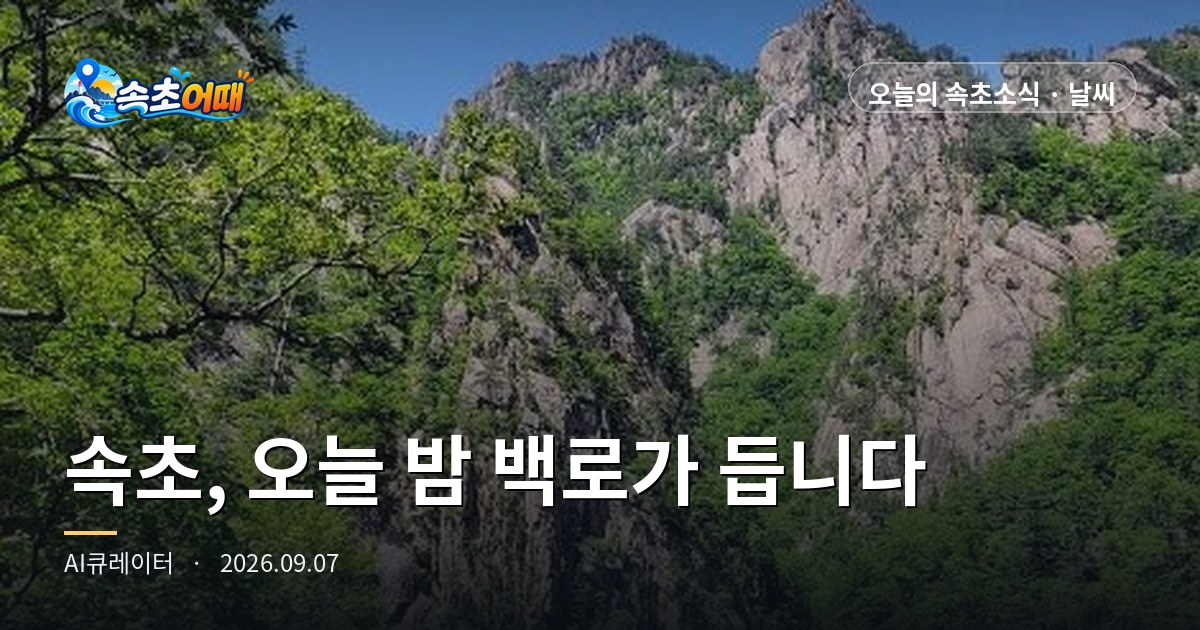
This autumn's first colors on Seoraksan are expected between late September and early October, with the peak from mid- to late October. With average temperatures in September and October forecast to run above normal, there is mention that both the first colors and the peak could come later than in past years. As of today, that leaves roughly 20 days until the first colors.
Why that number matters is that the next two to three weeks are the last stretch in which you can see Seoraksan without being jostled by crowds. The cable car's peak season starts September 19, the Chuseok holiday runs from September 24 to 27 (Chuseok itself falls on Friday, September 25), and from October 2 to 4 the 61st Seorak Cultural Festival will be held around the Sokcho Expo lawn plaza and Seorak Rodeo Street (설악로데오거리). Add the peak of the autumn colors on top of that and the approach road into Seorakdong becomes a different city for all of October.
Put the other way, for anyone who wants to walk a still-green Seorak quietly, today through next week is actually the best time. On September 20, the Dalma Ridge Trail Walk, a pre-event of the Seorak Cultural Festival, will start from Seolhyang Park in Seorakdong and run along Seorak Hyanggiro and past Dalmabong, Gyejoam, and Sinheungsa to Sogongwon, and on October 3 street parades are scheduled twice, at 2 p.m. and 5 p.m., on Seorak Rodeo Street. 속초어때 keeps track of these day-by-day congestion patterns, so checking once before you set your schedule will make things much easier.
If It's a Rainy Afternoon, Here's How Sokcho's Indoor Side Runs Today
On a Monday afternoon with a 78% chance of rain, if your outdoor plans have fallen apart, the alternative is the Culture & Arts Center. Sokcho's performance and exhibition calendar is unusually packed for the month of September.
- September 12 Arko Violin Ensemble regular concert (Small Hall, free)
- September 15 ‘우리의 가곡, 마음을 잇다’ (Our Art Songs, Connecting Hearts) (Grand Theater, hosted by the Sokcho Music Association, free)
- September 17 갯마당 (Gaetmadang) gugak performance (Grand Theater)
- September 19 The madanggeuk play ‘쪽빛황혼’ (Indigo Twilight) (Grand Theater, 20,000 KRW / 50% off for Seorak-area residents)
- For exhibitions, the Sokcho Culture & Arts Center exhibition hall hosts the Yeongnangho (영랑호) Chilseok Culture Festival Exhibition from September 12 to 16 and the ‘Harmony of Ripples, Light and Reflection’ photo exhibition from September 17 to 22, followed by the Hojeong Jo Jeong-seung retrospective from September 29 to October 4.
There are two free performances, and even the paid one comes with a large discount for local residents. It makes for a far more memorable day than drifting from café to café in the rain.
Three Approach Roads — Today the Roads Around Town Are Slower Than the Roads In
Here is the traffic situation coming into Sokcho as of 2 p.m. Misiryeong-ro (미시령로, toward Seoul) is flowing freely, while Donghae-daero (동해대로, coast and downtown) and Seoraksan-ro (설악산로, toward Seorak) are slow.
The pattern is the exact opposite of the weekend. On weekends it is Misiryeong-ro, the road in and out of Seoul, that jams; today that road is clear and the roads running between downtown and Seorakdong are slow. It means what is left after the student groups departed is everyday downtown traffic plus tourist vehicles heading for Seoraksan. So the drive into Sokcho itself is easy today. Just allow about 30 minutes extra if you plan to go straight to Seorakdong, and when moving from downtown to Daepohang or Oeongchi, it is better to take the road one block inland instead of Donghae-daero. Once the rain starts, the slow stretches will get longer.
Today's News for Sokcho Residents
- An analysis has found that the Livelihood Recovery Support Payment produced a clear short-term effect on the local commercial district. At the same time, it was pointed out that the effect is unlikely to last. It is worth checking the usage deadline and the range of participating stores once more.
- The budget for removing the Yeongnangho pontoon bridge has passed, and the removal process now gets under way in earnest. It is a decision to spend 700 million KRW taking down a 400 m pontoon bridge that cost 2.2 billion KRW to put in. The experience of walking across the water to cross Yeongnangho now has a fixed amount of time left.
- Unreasonable standards for vehicle-scrapping fines have been improved. If you are planning to scrap a car, check the revised standards.
- A civic group, 시민권리속초 (Citizens' Rights Sokcho), which puts municipal oversight and policy alternatives at the center of its work, has launched, and a Sokcho-style tailored jobs policy covering everyone from young people to seniors has also gotten under way.
Today, Summed Up in Numbers
- Temperature 24°C / low 19°C / 78% chance of rain — umbrella and an extra layer essential
- Water 24.2°C / waves 1.2 m — no going in; a sea for walking and looking
- Tide 3-mul / low tide 7:02 p.m. / sunset 6:47 p.m.
- Congested spots: just one, Sinheungsa (Seoraksan); everywhere else moderate
- Misiryeong-ro flowing / Donghae-daero and Seoraksan-ro slow
- Baengno begins tonight at 11:41 p.m. / about 20 days to Seoraksan's first autumn colors
Once 11:41 tonight passes, summer in Sokcho is over on the calendar. In truth, the water temperature, the daily temperature swing, and the congestion map of the tourist spots had all been tilting toward autumn for days already. A solar term is something like a stamp that confirms the change after the fact. If rain starts falling outside your window this evening, you might think of it as the sound of autumn opening its door in Sokcho.
Today we looked at the weather and the sea in Sokcho on September 7, the day Baengno arrives, along with congestion at Seoraksan and the travel timing for the next three weeks — was it useful? We will be back next time with even more useful information.